Secondhand Dining Tables and Chairs in Melbourne: A Buyer's Guide
Buying a secondhand dining table and chairs in Melbourne? Learn how to size the table, check extension mechanisms and chair fit, and spot problems before you pay.
Quick summary
Buying a secondhand dining table and chairs in Melbourne comes down to three checks: whether the table fits your room with space to move around it, whether the chairs suit the table's height and are structurally sound, and whether any extension mechanism works smoothly. This guide covers sizing, extension tables, chair fit and a condition checklist, so you can inspect before you pay.
Start with the room, not the table, when you're buying a secondhand dining table and chairs in Melbourne. Measure the space, leave room for chairs to pull out, and count how many people sit down on an ordinary night rather than at Christmas. The sections below turn that into numbers, then cover the mechanisms, materials, joints and chair details that most often go wrong on older tables.
How Big a Dining Table Do You Need?
According to Metro Elegance's Australian dining table size guide, allow about 60 cm of table edge per adult diner and around 90 cm of clearance between the table edge and the nearest wall or furniture, so chairs can pull out and people can walk behind them. The same guide gives these starting ranges:
| Seats | Rectangular table length | Round table diameter |
|---|---|---|
| 4 people | About 120–150 cm | About 90–120 cm |
| 6 people | About 150–180 cm | About 120–150 cm |
| 8 people | About 200–240 cm | About 150–180 cm (in a broad room) |
Treat these as starting points. Secondhand tables rarely follow today's standard sizes, so ask the seller for the exact length, width, height and leg position. Legs set at the corners can reduce usable seat space. To test the fit, mark the table's footprint on the floor with painter's tape and pull a chair out on each side.
Round, Rectangular, Square or Extension Table?
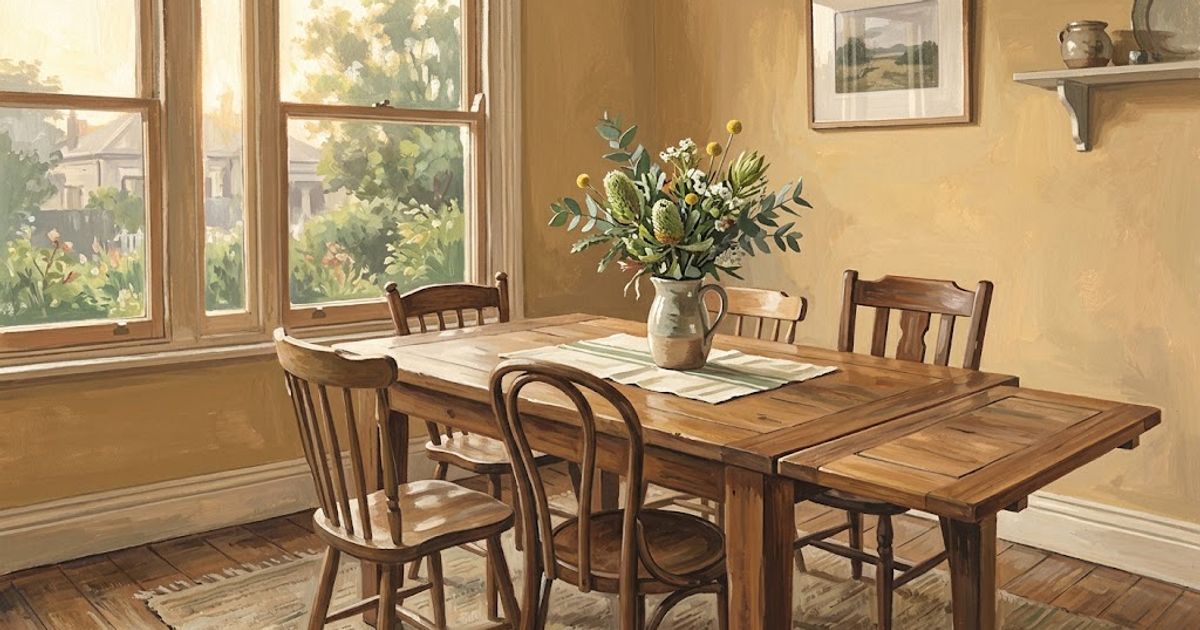
Shape changes how a room feels. Round tables suit squarer rooms and apartments because there are no corners to catch, though a large diameter takes space in every direction. Square tables suit compact dining nooks and smaller groups, but a large square makes the middle hard to reach. Rectangular tables suit longer rooms and make better use of floor area for bigger groups. An extendable dining table can cover both everyday dining and the occasional dinner party. That is useful in a smaller home, but only if the mechanism still works, which is the first thing to test.
How to Check an Extension Table Mechanism
Older extension tables come in a few common types:
- Drop-leaf: Hinged flaps fold down when not needed.
- Draw-leaf (pull-apart): The ends slide apart and leaves stored underneath rise into the gap.
- Butterfly leaf: A folded leaf stored inside the table opens out.
- Loose leaf: A separate panel dropped into the gap.
Open and close it fully at least twice before you buy. Watch for:
- Sticking, grinding or leaf edges that don't sit flush.
- Missing leaves, pins or catches. Ask for all of them.
- Cracked runners or loose supports.
- A stored leaf that doesn't match the tabletop's colour or grain, since leaves kept in a cupboard age differently.
- Wobble when the table is fully extended.
How to Choose Dining Chairs That Fit the Table
Chair height matters as much as chair style. According to Oak Furniture Store's Australian sizing guide, standard dining tables are about 74–76 cm high and standard chair seats about 45–48 cm high, which leaves a gap of 25–30 cm between the seat and the underside of the tabletop. Tighter than that and thighs hit the apron. Looser and the table feels too high. Measure the table and each chair before you buy, because older sets can differ.
Check chair width as well as seat height. Armchairs take up more space and can reduce the number of chairs that comfortably fit around the table, so count chairs against the table's real capacity, not just how many fit around the edge.
Chairs don't have to match the table. Mixed chairs can look deliberate if they share one element, such as seat height, timber tone or silhouette. Seat height is the one thing that must be consistent. Our guide to mixing secondhand and new furniture covers how to keep a mixed set looking intentional.
Solid Timber, Veneer or MDF: What Is the Table Made Of?
Check the material before you judge the price. Solid timber can usually be sanded and refinished if the surface is marked. Veneer is a thin layer of timber over a core. It can look like solid wood, but lifting edges, bubbling or cracks suggest moisture or age damage. MDF and particleboard are made from bonded wood fibre or chips, and they can swell if they've absorbed water, so check edges, corners and the underside for puffiness or crumbling. If you can't tell what the top is made of, ask the seller and look at an edge or the underside, where layers or a bonded core are easier to spot.
Secondhand Dining Table and Chairs Checklist
| Check | What to look for | Walk away if |
|---|---|---|
| Tabletop | Light scratches, minor water rings, an even finish | Veneer is lifting, edges are swollen, or deep damage spans the surface |
| Legs and frame | Firm when you push the table side to side | Joints are cracked or the frame is racking |
| Underside | Clean joinery, no stains or damp smell | Mould or moisture damage |
| Timber | Sound grain, no active borer signs (fresh small round holes with fine dust) | Fresh holes and dust are present |
| Extension mechanism | Smooth, flush and complete with all leaves | Parts are missing or the table is unstable when extended |
| Chair joints | Firm legs, backs and rails when you sit and lean | Chairs creak, wobble or have split rails |
| Chair seats | Even padding, clean fabric or intact timber seats | Heavy stains, odours or collapsed padding |
| Measurements | Table height, seat height, length and width confirmed | Dimensions are unknown or don't suit your space |
Our guide to telling if secondhand furniture is good quality goes deeper on construction. Once the set is home, see how to clean a wooden dining table without damaging the finish.
Where to Find Secondhand Dining Tables and Chairs in Melbourne
You can browse secondhand dining tables and chairs in Melbourne on Zirkly by suburb, starting with the dining tables category. Suburb pages such as Fitzroy North show what local sellers have listed, which helps when you want to inspect in person and collect nearby. Tables and chairs are often listed together as a set, which can make matching easier, but check the chair dimensions separately.
For other channels, including markets, vintage dealers and op shops, our guide to where to buy secondhand furniture in Melbourne covers each one. For price expectations, see the pricing guide rather than relying on a single listing.
Getting a Dining Table Home
A dining table is awkward long before it is heavy. Measure the front door, hallway, stairs and any tight turns, as well as the room. Our guide to measuring doorways for secondhand furniture shows how. Ask whether the legs detach, because removing them often makes a table far easier to carry. Wrap the top to protect the finish. If you only have a hatchback or sedan, our guide to transporting furniture in a regular car covers what fits and how to secure it.
Is a Secondhand Dining Table and Chairs Set Worth Buying in Melbourne?
A secondhand dining table and chairs can be a good buy when you measure first, test the legs and any extension mechanism, and confirm that the chairs suit the table's height. Solid pieces in sound condition are worth pursuing, while wobbly frames and missing parts are not worth the discount.
Ready to find your table? Browse secondhand furniture on Zirkly, and if you're replacing a set, you can also sell your old dining table and chairs to local Melbourne buyers.
Frequently Asked Questions
What size secondhand dining table do I need for 4, 6 or 8 people?
As starting ranges, a rectangular table of about 120–150 cm suits four, about 150–180 cm suits six, and about 200–240 cm suits eight, allowing roughly 60 cm of table edge per person. Round tables need about 90–120 cm, 120–150 cm and 150–180 cm for the same groups. Always confirm the seller's exact measurements and allow around 90 cm of clearance where chairs need to be pulled out and people need to walk behind them.
Where can I buy a secondhand dining table and chairs in Melbourne?
Zirkly lists tables and chairs from local sellers, and markets, vintage dealers and op shops are other channels, though stock varies. Tables and chairs are often listed together as sets, so check that the chair dimensions suit the table.
How do I find a secondhand dining table near me in Melbourne?
Browse Zirkly by suburb and distance, compare listings of similar size and material, and check the dimensions and condition before you travel. Message the seller for exact measurements and photos of the underside and any extension leaves.
How much should I pay for a secondhand dining table?
Price depends on size, material, condition and whether chairs are included, so compare several similar listings instead of relying on one. Solid timber in sound condition usually justifies a higher price than a damaged or particleboard table. Use Zirkly's pricing guide for how to read comparables.
How do I check a secondhand extension dining table?
Extend and close it fully at least twice, checking that the leaves sit flush, the mechanism moves smoothly, and all leaves and catches are present. Make sure the table stays stable when extended and that stored leaves match the tabletop.
Do dining chairs have to match the table?
No. Chairs can differ in style, but seat height should suit the table. A gap of about 25–30 cm between the seat and the underside of the tabletop is a common guideline. Keep at least one element consistent, such as seat height or timber tone.
Will a secondhand dining table fit through my door and stairs?
Measure the table's longest and widest dimensions against your doorways, hallways, stairs and turns before buying. Ask whether the legs detach, as this often makes it easier to carry and fit.
Adam
Zirkly Team
Adam turns complex secondhand furniture topics into practical advice for Melbourne buyers and sellers — pricing, safety and the decisions that make buying and selling used furniture clearer.