Small Apartment & Studio Furniture Ideas (Secondhand Guide)
Furnishing a studio or small apartment isn't about budget, it's about footprint. Secondhand furniture ideas, sizing tips and a checklist before you buy.
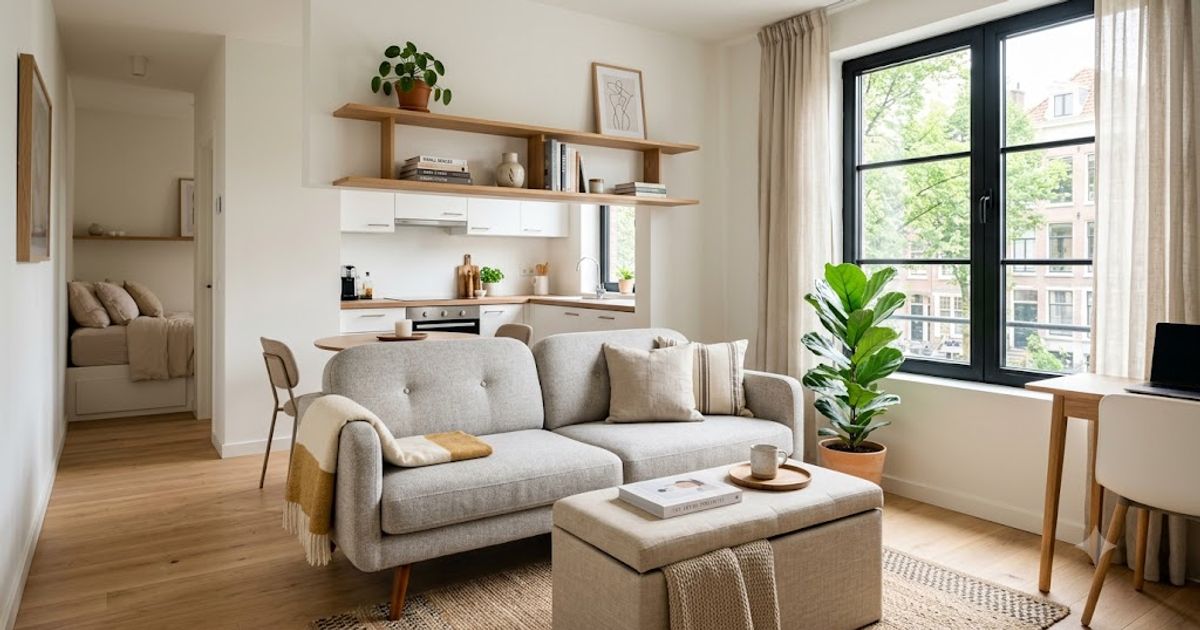
Furnishing a studio or small apartment is a different problem to furnishing a house. It's not really about budget, though budget still matters — it's about footprint. Every piece has to earn its square metre in a compact apartment, and the wrong choice doesn't just look bad, it makes the whole space feel smaller than it is.
The good news is that secondhand furniture is often better suited to small spaces than new, not worse. Older furniture was frequently built to smaller, more modest proportions than a lot of what's sold new today, and the secondhand market gives you far more control over exact dimensions than picking from a handful of new ranges. This guide covers what actually works for compact living in a studio or one-bedroom apartment, and how to shop for it secondhand.
Small-space furniture, in practice, just means furniture chosen to maximise usable living space — combining multiple functions or reducing floor area without giving up comfort. That idea runs through everything below.
Measure your small apartment before buying furniture
In a studio, the room decides what you can buy before taste ever gets a say. Measure the space for every piece you're considering before you go looking — the wall length for a sofa, the clearance a door needs to swing, the gap a dining chair needs to be pulled out and sat in comfortably. A secondhand piece is a bargain right up until it doesn't fit, at which point it's just something to resell at a loss.
It's worth measuring doorways and lift dimensions too if you're above the ground floor. Melbourne's inner-city high-rise pockets — Docklands, Southbank, the CBD fringe, and apartment-heavy suburbs like Carlton, Brunswick, Richmond and Fitzroy — put a lot of well-designed compact apartments above ground level, and a sofa that fits the room's floor plan perfectly is no use if it can't get there.
Multi-functional pieces that earn their square footage
The single best lever in a small space is furniture that does two jobs instead of one. A few reliable examples:
- A storage ottoman instead of a coffee table — seating, a surface, and hidden storage in the one footprint.
- A sofa bed or daybed for a studio that needs to host overnight guests occasionally, without dedicating floor space to a bed nobody uses most nights. A two-seater often works better than a three-seater in a studio, since it leaves room to actually walk around it — bigger isn't automatically better once circulation space runs out.
- An extendable or drop-leaf dining table that's compact day to day and expands when you actually need the extra room. Round tables generally allow easier movement around them than a square or rectangular table with the same seating capacity, since there's no sharp corner to navigate.
- Nesting side tables that tuck away to almost nothing and pull out only when a second surface is genuinely needed.
- A bed frame with built-in storage drawers underneath, which quietly replaces a chest of drawers you'd otherwise need to find room for — and if floor space is especially tight, a fold-away or Murphy-style bed frame turns the same square metres into a living room by day and a bedroom by night.
None of these space-saving furniture pieces are hard to find secondhand — if anything, older multi-functional furniture (extendable tables especially) was a much more common design brief decades ago than it is in a lot of mass-market new furniture today.
One habit worth building before you buy: picture the piece doing its second job, not just its first. A coffee table that "could" hide storage but has no real access underneath isn't multi-functional, it's just a coffee table with a marketing description. Check the mechanism, the access, and whether it's actually easy to use day to day — a sofa bed you dread unfolding gets used as a permanent bed within a month, which defeats the whole point of buying one. The same logic applies to a fold-away desk for a home office corner — our guide to setting up a home office with secondhand furniture covers finding a desk and chair that earn their space the same way.
Furniture that makes a small apartment feel bigger
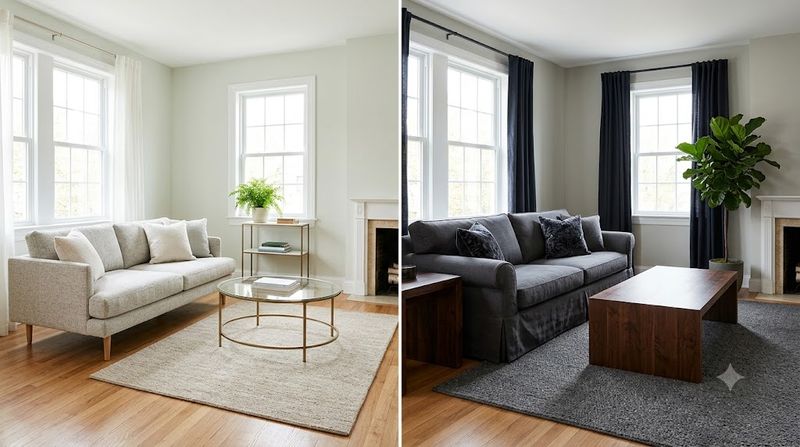
Two rooms with the same square metres can feel completely different sizes depending on the furniture in them, and it's rarely about how much furniture there is — it's about how much of the floor and wall you can still see. Getting the apartment layout right starts here, before storage or style.
Opens the room up: furniture on visible legs rather than furniture that sits flush to the floor, glass or light-toned tabletops, pale upholstery, anything low-profile that doesn't block sightlines across the room. A sofa you can see under reads as smaller than a sofa that hides the floor behind it, even at the same dimensions.
Shrinks the room: bulky upholstered pieces with skirting down to the floor, dark solid blocks of furniture with no visual break, anything tall and opaque positioned where it blocks a sightline to a window. None of this means avoiding character or timber — our guide to mixing secondhand and new furniture covers how scale and proportion do more work than colour or style, and the same logic applies doubly in a small room.
Use vertical storage in small apartments
Floor space is the scarcest resource in a studio, and wall space is usually sitting there unused. Wall-mounted floating shelves, a tall narrow bookshelf instead of a low wide one, and hooks or a slim console instead of a floor-standing unit all maximise storage without eating into limited floor space.
The same principle applies to what you put on the floor you do use: furniture with a small footprint but real height — a narrow bookshelf, a tall slim cabinet — stores as much as a bulky low piece while taking up a fraction of the floor. Under-bed storage does similar work for anything you don't need daily access to.
Why secondhand has a real advantage in small spaces
This is worth saying plainly: for a studio or small apartment, secondhand isn't just the cheaper option — it's often the better-fitting one. New furniture ranges are frequently designed around an average that skews larger than what a compact apartment actually needs, and buying new usually means picking from whatever a handful of retailers happen to be selling that season rather than what your exact room requires.
The secondhand market has no such limits — after decades of furniture entering Melbourne's secondhand market, there's simply a much wider spread of dimensions circulating than any single retailer could ever stock in one season. Buying new often means choosing between a handful of standard sizes. Shopping secondhand is different — because you're browsing individual pieces rather than a seasonal collection, you're much more likely to find a sofa that's 15 centimetres shorter, a bookshelf that's slightly narrower, or a dining table that fits an awkward corner perfectly. In a studio or small apartment, those small dimensional differences can completely change how a room functions. Our guide to vintage versus secondhand furniture is worth a look if you're drawn to older, smaller-scaled pieces specifically — a lot of genuinely well-made vintage furniture was built for exactly the kind of compact room a lot of new furniture ignores.
A few things to skip in a small space
Some furniture is a mistake in a studio regardless of how good a deal it is:
- An oversized sectional. Beautiful in a big living room, a floor-plan problem in a studio — it usually dictates the entire layout around it.
- A large solid dining set. A drop-leaf or a compact round table almost always serves a studio better than a full six-seater that sits half-used most days.
- A bulky entertainment unit. Wall-mounting a TV and using slim floating shelving instead frees up an enormous amount of floor for very little cost.
- Anything bought "because it was cheap," regardless of size. A great price on the wrong-sized piece is still the wrong-sized piece — our guide to what secondhand furniture actually sells is useful if you're not sure whether a piece is worth the space it'll take, and our guide to pricing secondhand furniture in Melbourne helps make sure a good deal is actually a good deal.
Checklist before buying secondhand furniture for a small apartment
- Measure the room, not just the wall the piece will sit against
- Measure doors and lifts if you're not on the ground floor
- Check the seller's listed furniture dimensions before travelling to see it
- Leave enough walking space once the piece is in place — not just floor space for it to sit on
- Prioritise multi-functional pieces over single-purpose ones
- Consider vertical storage before adding another floor-standing piece
- Inspect any moving parts (drawers, sofa-bed mechanisms, extendable leaves) in person
- Plan how you'll transport it before you commit to buying
Looking for secondhand furniture that actually fits your studio or small apartment? Browse local Melbourne listings on Zirkly, compare dimensions before you travel, and find pieces sized for compact living — or list what's too big for yours for free, since someone with more room than you is probably looking for exactly that piece.
Frequently Asked Questions
What furniture is best for a small studio apartment in Melbourne?
Multi-functional pieces do the most work — a storage ottoman, an extendable table, a bed with built-in drawers. Beyond function, furniture on visible legs and in lighter tones tends to make the space feel bigger than bulky, floor-hugging pieces of the same actual size.
How do I make a small apartment feel bigger with furniture?
Choose pieces that let you see floor and wall behind them — legs rather than skirting, glass or light tabletops, low-profile silhouettes — and move storage onto the walls rather than the floor wherever possible. It's less about how much furniture is in the room and more about how much of the room you can still see.
Is secondhand furniture good for small apartments?
Often better suited than new. Secondhand furniture spans decades of sizes and styles rather than one season's retail range, which makes it easier to find something genuinely proportioned for a small room rather than settling for whatever a handful of new options happen to offer.
What furniture should I avoid in a studio apartment?
Oversized sectionals, large solid dining sets and bulky entertainment units are the most common studio mistakes — each one tends to dictate the whole room's layout around it. A compact, multi-functional alternative almost always serves a small space better.
Can multi-functional furniture be found secondhand?
Yes, and often more easily than expected — extendable and drop-leaf tables, storage ottomans and bed frames with built-in drawers were common design features well before they became a small-space trend, so plenty of well-made examples are circulating secondhand.
Where can I buy small-space furniture in Melbourne?
Local marketplaces like Zirkly let you filter by category and browse listings near you, which matters more for compact furniture than most categories — you're often looking for a specific size rather than just a general style, and local pickup means you can check the fit before committing.
What size sofa is best for a studio apartment?
A two-seater usually works better than a three-seater in a studio, even when a three-seater would technically fit against the wall — the extra length often eats into the walking space you need to actually move around it. Measure the clear floor space you'd have left, not just the wall length, before deciding.
How do I measure furniture before buying secondhand?
Ask the seller for width, depth and height rather than relying on photos, and measure your own space the same way — including door and lift clearances if the piece needs to travel through them. A quick tape-measure check against the listing's dimensions before you travel to see it saves a wasted trip either way.
Erica
Zirkly Team
Erica covers interior styling, furniture trends and the vintage pieces worth knowing about, helping Melbourne buyers and sellers make secondhand furniture feel like a deliberate choice rather than a compromise.