Vintage vs Secondhand Furniture — What's the Difference and Which Is Worth More?
Vintage, secondhand, antique, retro — what do these terms actually mean, and which furniture is worth more? A clear Melbourne guide to the differences, the values, and what to look for.
The confusion — and why it costs Melbourne buyers and sellers money
Walk into any secondhand furniture shop in Melbourne and you'll see the same words scattered across price tags and listing descriptions: vintage, retro, antique, preloved, secondhand, used. Most people use these terms interchangeably. In practice, they mean very different things — and getting them wrong costs both buyers and sellers real money.
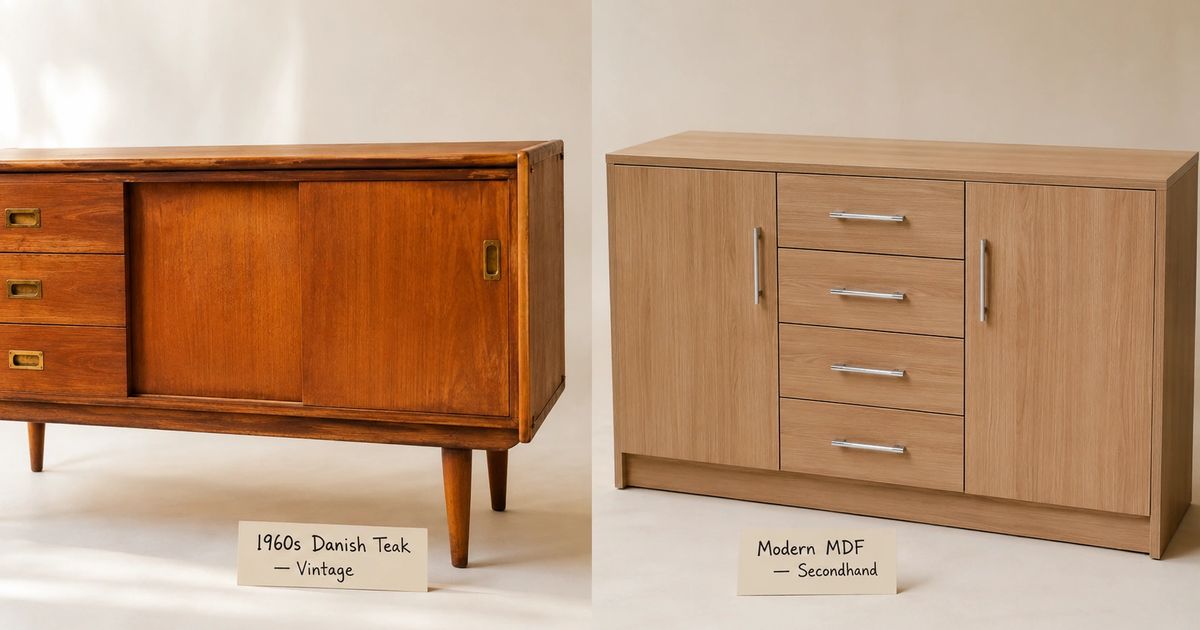
A seller who lists a genuine 1960s Danish teak sideboard as "secondhand furniture" is likely to price it at $150–$300 and have it snapped up within hours by a buyer who knows exactly what they're looking at. That same piece, correctly identified as mid-century vintage Scandinavian, could sell for $700–$1,400 or more at a Melbourne vintage dealer — and up to $4,500 if it carries a named designer's mark.
On the buyer side, a sofa described as "vintage" that turns out to be a retro-style reproduction from 2018 is worth a fraction of an authentic 1960s original — but without knowing the difference, it's easy to overpay.
This guide clears up every term, explains which categories are genuinely worth more, and tells you how to identify what you're actually looking at when you're buying or selling furniture in Melbourne.
The definitions: vintage, secondhand, antique, retro, and reproduction
Secondhand furniture
Secondhand furniture is the broadest category — it simply means any furniture that has had at least one previous owner, regardless of age, style, or quality. A flat-pack bookshelf bought from IKEA last year and resold is secondhand. So is a 1920s armchair. The word says nothing about value, age, or design quality — only that the piece is used.
Most furniture traded on platforms like Zirkly is secondhand furniture: sofas, dining tables, beds, dressers, and bookshelves that people no longer need and want to pass on to the next owner.
Vintage furniture
Vintage furniture refers to pieces that are old enough to represent a specific design era — typically between 20 and 99 years old. A Melbourne professional organiser recently described the definition clearly: furniture is commonly considered vintage when it is between 20 and 99 years old, and is valued for representing a specific era or design trend. Think mid-century modern furniture from the 1950s and 1960s, art deco pieces from the 1920s and 1930s, or 1970s retro timber pieces.
The key distinction is intent: vintage furniture is sought for its design, era, and character — not just because it's used. A 1960s teak sideboard isn't valuable merely because it's old; it's valuable because it represents a period of exceptional Scandinavian design craftsmanship that cannot be replicated by modern mass production at any similar price point.
Not all old furniture is vintage in the meaningful sense. A MDF bookshelf from 2004 is technically old enough to be "vintage" by a strict age definition, but it has no design significance, depreciates rather than appreciates, and nobody is hunting for it. True vintage status requires both age and design or cultural relevance.
Antique furniture
Antique furniture meets a stricter standard: to be classified as an antique, a piece must be at least 100 years old. Victorian sideboards, Federation-era chairs, and Edwardian dining tables all qualify as antiques. Antiques are valued not just for their design but for their historical significance, their craftsmanship, and the materials and methods of their era — things that genuinely cannot be reproduced today.
Antique furniture typically commands the highest prices, particularly when it retains its original materials and finish. Restoration is acceptable but should preserve as much of the original fabric as possible — heavily altered antiques lose authenticity and value.
Retro furniture
Retro does not refer to age at all. Retro refers to style — specifically, new or recent furniture designed to look like it belongs to a past era. A brand-new dining table manufactured in 2026 with tapered legs and a walnut veneer designed to evoke the 1960s is retro, not vintage. It mimics the aesthetic of mid-century modern without being part of that era.
Retro furniture can be well-made and attractive, but it does not carry the value of authentic vintage pieces. A retro-style teak sideboard manufactured in 2020 and sold for $800 will depreciate like any other new furniture. The authentic 1960s sideboard it imitates will hold or increase its value.
Reproduction furniture
Reproduction furniture is made to replicate a specific historical style or designer's work — French Provincial, Art Deco, mid-century modern — using modern materials and manufacturing. It is not the same as a licensed reissue (Herman Miller still produces the Eames Lounge Chair under licence, which retains significant value). An unlicensed reproduction of a Hans Wegner chair made in 2015 has essentially standard secondhand furniture value regardless of how well it is made.
The terms at a glance
| Term | What it means | Age | Value driver |
|---|---|---|---|
| Secondhand | Previously owned | Any | Condition and demand |
| Vintage | Old enough to represent a design era | 20–99 years | Age, design, era, materials |
| Antique | Historical artefact | 100+ | Age, originality, craftsmanship |
| Retro | New piece styled to look old | New | Style preference, not age |
| Reproduction | Modern copy of a historical style | New | Quality of construction only |
Which is worth more — vintage or secondhand?
Vintage furniture is almost always worth more than standard secondhand furniture of the same apparent type — but the gap depends entirely on what the piece is, its condition, and whether it can be authenticated.
Here is a realistic comparison using Melbourne market data:
Standard secondhand sofa (2018, good condition): $150–$350 Authentic 1960s mid-century modern sofa (good condition, original upholstery): $800–$3,000+
Standard secondhand timber sideboard (2015, good condition): $80–$200 Authentic 1960s Danish teak sideboard (good condition): $700–$1,400 Authentic 1960s Danish teak sideboard with named designer mark: $2,000–$4,500
Standard secondhand timber dining table (2016): $100–$300 Authentic 1960s Danish teak dining set with six chairs: $1,300–$2,000
Some of the most highly sought after used furniture in Melbourne are sideboards and tables from the 1960s. Scandinavian furniture sells for in excess of $1,000 in many Melbourne shops — and when genuine pieces reach auction houses, they are snapped up very quickly. — Abbeys Auctions Melbourne
The critical caveat: not every old piece of furniture is valuable. Vintage value is specific to pieces with genuine design significance — mid-century Scandinavian, art deco, Victorian, Australian craftsman timber. A piece of flat-pack furniture from the 1990s is old but not valuable. Understanding which categories carry genuine vintage value is the skill that separates buyers who get great deals from buyers who overpay for interesting-looking junk.
How to tell if a piece is genuinely vintage
The Melbourne market has no shortage of sellers describing retro-style reproductions as "vintage" — sometimes innocently, sometimes not. Here is how to distinguish the real thing.
Check the construction method
Genuine pre-1980s furniture was almost universally built using solid wood, traditional joinery, and hand-finished details. Run your hands under the piece and along the back panels. Look at the underside of drawers and shelves. Signs of authentic vintage construction include:
- Dovetail joints in drawer construction — the interlocking finger joints visible when you pull out a drawer. Machine-cut dovetails appeared in the 1950s; hand-cut dovetails indicate earlier craftsmanship.
- Solid timber throughout — tap the surface and listen. Solid wood has a distinct resonance that particle board and MDF don't produce. Look at the edge grain on shelves and table edges — solid wood shows continuous grain throughout, while veneer shows a thin contrasting layer.
- Mortise-and-tenon or wooden peg joinery in chair and table frames — these indicate quality pre-modern construction.
- Original hardware — hinges, handles, and drawer pulls on authentic vintage pieces often show patina, minor wear, and manufacture marks from their era.
Look for maker's marks
Authentic mid-century Scandinavian furniture almost always carries identification marks. Look for the round "Made in Denmark" control mark and brass-plate maker tags on the underside of Danish teak pieces. Pieces by named designers — Hans Wegner, Arne Jacobsen, Ib Kofod-Larsen — carry maker labels burned into the underside or stamped into the back panel. The presence of these marks moves a piece from the general secondhand market into the vintage collector market and dramatically affects its value.
Assess the materials
Vintage pieces are often sought after because they represent a specific era or design trend — think mid-century modern furniture from the 1950s and 60s, valued for the specific aesthetic or the sense of nostalgia they evoke. The materials that define this era are solid teak, walnut, rosewood, and oak — all of which have a weight, warmth, and grain character that modern reproductions using veneers over MDF cannot replicate convincingly at close inspection.
Check the patina
Genuine age shows in a piece's patina — the natural darkening and character that wood develops over decades of exposure to light, air, and use. This cannot be faked convincingly. Reproduction pieces that have been artificially distressed or stained to look old typically look uniformly aged in a way that real patina does not.
Research the style period
Mid-century modern design (roughly 1945–1975) has very specific visual hallmarks: tapered legs, clean horizontal lines, minimal ornamentation, teak or walnut construction, organic forms. If a piece looks right for the era, check whether its construction matches. A piece that looks mid-century but has modern hardware, MDF backing panels, or cam-lock fittings is a reproduction.
The most valuable vintage furniture categories in Melbourne right now
Mid-century modern Scandinavian furniture (1950s–1970s)
The single most actively traded and highest-value vintage furniture category in Melbourne. According to Item Value Checker, Danish modern teak credenzas, sideboards, and dining sets are having a strong 2026 — pieces by named designers routinely clear $2,000–$4,500, while unmarked Danish teak credenzas of similar quality sell for $700–$1,400. Melbourne has specialist dealers in Brunswick East (20th Century Scandinavia), Fitzroy, and Collingwood who focus almost exclusively on this category — which tells you everything about the local demand.
What to look for: teak sideboards, credenzas, dining sets, lounge chairs, and occasional tables from Danish and Swedish manufacturers from the 1950s–1970s. Named designers (Hans Wegner, Arne Jacobsen, Johannes Andersen) command a significant premium over unmarked pieces.
Australian craftsman timber furniture (pre-1970)
Australia has its own rich tradition of craftsman-built hardwood furniture that is frequently undervalued in the Melbourne secondhand market. Pre-1970 pieces built from Australian hardwoods — blackwood, huon pine, jarrah, silky oak — in the Federation, Art Deco, or mid-century styles are genuinely scarce, well-constructed, and increasingly collected. A well-preserved Australian craftsman sideboard or dining table from this era in solid hardwood can sell for $500–$1,500 in Melbourne's specialist market.
Victorian and Edwardian antiques (pre-1920)
The antique category proper — pieces over 100 years old. Victorian mahogany sideboards, Edwardian dining suites, and Federation-era Australian pieces attract a dedicated collector market in Melbourne. A Victorian mahogany sideboard with original hardware in good condition sells for $700–$1,800 locally. The limitation is transport — these are heavy, large pieces and the buyer pool is necessarily geographic.
Art deco pieces (1920s–1940s)
Art deco furniture is having a sustained moment in Melbourne's design market. The geometric forms, exotic timber veneers, and chrome accents of the 1920s–1940s have a strong visual identity that translates well into contemporary interiors. Genuine art deco pieces in good condition — drinks cabinets, dressers, dining chairs — regularly sell for $400–$1,200 in Melbourne.
1970s Australian retro timber
Lower on the value scale than Danish mid-century but increasingly collected: Australian-made timber furniture from the 1970s — particularly solid pine, teak veneer, or blackwood pieces with the characteristic chunky proportions of the era. These pieces are at the beginning of their appreciation curve and currently represent good value — bought for $50–$200 in the general secondhand market, and increasingly sought by buyers who appreciate the era's aesthetic.
What makes vintage furniture go up in value over time
Not all vintage furniture appreciates. The pieces that go up in value share a specific set of characteristics.
Named designer or maker. A piece attributable to a recognised designer commands multiples of the value of a comparable anonymous piece. This gap widens over time as the designer's reputation is sustained by museum collections, monographs, and continued collector interest.
Original condition. Buyers of serious mid-century furniture generally prefer original finishes, even with patina and age, over pieces that have been refinished. The authenticity of the original surface is part of what buyers are buying. A 1960s teak sideboard with its original oil finish, slightly aged, is more valuable than the same sideboard that's been sanded and lacquered.
Solid material construction. Pieces built from genuine solid timber — teak, walnut, oak, rosewood — hold value. Pieces using veneer over MDF or particle board cores deteriorate over time and do not appreciate.
Scarcity. As genuine vintage pieces are damaged, destroyed, or leave the market permanently, the remaining examples become more valuable. This is the fundamental economics of collecting — supply only decreases over time.
Sustained design relevance. Mid-century modern has been the dominant design aesthetic in Australian interior styling for over a decade and shows no signs of fading. Pieces that fit naturally into contemporary Melbourne homes attract a large, active buyer pool that keeps prices strong.
How to buy and sell vintage furniture in Melbourne
Buying vintage furniture in Melbourne
The best opportunities for buying genuine vintage furniture in Melbourne at below-market prices are in the general secondhand market — where sellers don't know what they have, or don't have the time or platform to reach the specialist vintage buyer.
Zirkly — Melbourne's dedicated secondhand furniture marketplace — is worth searching specifically for teak, Danish, mid-century, walnut, and vintage as keywords. Private sellers listing genuine vintage pieces as general secondhand furniture are common, and the prices reflect the secondhand market rather than the vintage dealer market.
The Camberwell Sunday Market and the Bentleigh Sunday Market are Melbourne's two best open-air markets for finding undervalued vintage pieces. Arrive early — the best pieces go in the first hour.
Melbourne op shops occasionally have genuine vintage pieces, particularly Salvos and Vinnies stores in suburbs with older housing stock (inner-north, inner-east). These finds are rare but the prices when they occur are exceptional.
Selling vintage furniture in Melbourne
If you believe you have genuine vintage furniture — particularly mid-century Scandinavian, Victorian antiques, or Australian craftsman pieces — invest in identification before listing.
Check the underside and back panels for maker's marks, country of origin stamps, and designer labels. Search the maker and model on eBay's completed listings (filter for "sold") to see recent actual sale prices. Cross-check on 1stDibs and Chairish to see dealer asking prices — these run higher than private sale prices but establish the ceiling.
If you have a piece you believe is genuinely valuable but can't identify, Melbourne's specialist dealers — 20th Century Scandinavia in Brunswick East, Red Rider Vintage, Retro Rehab — will often give an informal assessment if you contact them with photos.
Correctly identifying and describing a piece as vintage rather than secondhand can be the difference between $150 and $1,400 for the same item. The research takes thirty minutes. The price difference is worth it.
List your furniture free on Zirkly — Melbourne's dedicated secondhand furniture marketplace — and include the era, material, construction details, and any maker marks in your description to attract the right buyers at the right price.
List vintage and secondhand furniture free on Zirkly
Whether you're selling a 1960s teak sideboard or a five-year-old sofa, Zirkly connects you with Melbourne buyers who know what they're looking for. List free, reach local buyers, and sell this week.
Frequently Asked Questions
What is the difference between vintage and secondhand furniture?
Secondhand means any previously owned furniture, regardless of age or style. Vintage specifically refers to furniture that is between 20 and 99 years old and represents a significant design era — mid-century modern, art deco, Victorian. All vintage furniture is secondhand, but not all secondhand furniture is vintage. The distinction matters significantly for value: a genuine 1960s Danish teak sideboard is worth $700–$1,400 as a vintage piece; the same item described as secondhand furniture in a general listing might sell for $150.
What is the difference between vintage and antique furniture?
Age is the dividing line. Vintage furniture is typically 20 to 99 years old. Antique furniture is at least 100 years old. Both terms imply design or historical significance — a 90-year-old piece of poor-quality furniture is not truly vintage in the meaningful sense just because of its age.
What is retro furniture?
Retro refers to style, not age. Retro furniture is new or modern furniture designed to look like it belongs to a past era. A new dining table with tapered legs designed to evoke the 1960s is retro. The authentic 1960s dining table it imitates is vintage. Retro furniture depreciates like any new furniture; vintage furniture can appreciate.
Is vintage furniture worth more than secondhand furniture in Melbourne?
Generally yes — significantly. A mid-century Danish teak sideboard in good condition sells for $700–$1,400 through Melbourne vintage dealers, while a comparable non-vintage timber sideboard might fetch $80–$200 in the general secondhand market. Named-designer vintage pieces command even higher premiums. The key is correct identification — many genuinely valuable vintage pieces are listed and sold as standard secondhand furniture by sellers who don't recognise what they have.
What vintage furniture is most valuable in Melbourne right now?
Mid-century modern Scandinavian furniture (Danish and Swedish teak pieces from the 1950s–1970s) is the most actively traded and highest-value vintage category in Melbourne. Named designer pieces by Hans Wegner, Arne Jacobsen, and Ib Kofod-Larsen command the highest prices. Australian craftsman hardwood furniture from the pre-1970s is increasingly collected and currently undervalued relative to Scandinavian equivalents.
How do I know if my furniture is genuinely vintage or a reproduction?
Check the construction: genuine vintage furniture uses solid timber, traditional joinery (dovetail drawers, mortise-and-tenon frames), and original hardware with patina. Look for maker's marks on the underside — Danish pieces often have "Made in Denmark" stamps and brass maker tags. Reproductions typically show MDF or particle board backing panels, modern hardware, and uniform ageing. If you're unsure, search the piece's style and construction details online, or contact a Melbourne vintage specialist with photos.
Where can I find genuine vintage furniture in Melbourne?
Zirkly is worth searching for vintage-specific keywords (teak, Danish, mid-century, walnut, vintage). Private sellers listing genuine vintage pieces in the general secondhand market are common and often priced below specialist dealer value. The Camberwell Sunday Market and Bentleigh Sunday Market are Melbourne's best open-air options — arrive early. Specialist dealers including 20th Century Scandinavia (Brunswick East) and Red Rider Vintage focus specifically on mid-century pieces.
Should I restore vintage furniture before selling it in Melbourne?
Generally no — at least not for major refinishing. Buyers of serious vintage furniture typically prefer original surfaces, even with age and patina, over pieces that have been refinished. Light cleaning and conditioning with the appropriate oil or wax is appropriate. Full sanding and restaining removes the original finish that collectors value and can reduce the sale price rather than increase it.
Sujith
Zirkly Team
Sujith is the Founder of Zirkly — Melbourne's dedicated secondhand furniture marketplace. With over 20 years of experience building digital products and leading product strategy, he writes about the secondhand furniture market, consumer behaviour, and the circular economy. His perspective combines technology, market research, and the experience of building a peer-to-peer furniture platform.