How to Transport Furniture in a Regular Car — No Ute Needed
No ute, no van, no removalist. Here is exactly how to transport secondhand furniture in a regular car — what fits, how to protect your boot, and when to hire a man-with-a-van instead.
You don't need a ute to move furniture
Here is the number one reason people don't follow through on a great secondhand furniture find: they assume they need a ute, a van, or a removalist to get it home.
They don't.
Most furniture — dining chairs, coffee tables, side tables, bookshelves, bedside tables, small sofas — fits in a regular hatchback, sedan or SUV when you know what you're doing. The people who struggle are almost always the ones who skip the measuring step, load without protection, or try to force something in without removing a few screws first.
This guide covers exactly how to do it properly: measure your boot, protect your car, use the partial dismantle trick where you need it, and strap everything so nothing moves when you brake.
Browse local secondhand furniture listings near you at zirkly.com.au — most pieces are close enough that a regular car is all you need.
Step 1 — Measure your boot before you go
The single most important thing you can do before picking up any secondhand furniture is measure your car's boot — and bring those measurements with you.
Here is how:
- Fold your rear seats completely flat
- Measure boot length (front of boot to back of rear seats when folded)
- Measure boot width at the widest point
- Measure boot height from floor to roof
- Screenshot or write it down — take it every time you shop
You will be surprised what fits when you know your actual dimensions. A 1.2m coffee table that looks impossibly long in someone's lounge room might slide in perfectly along the diagonal of your boot.
Before you commit to buying, ask the seller to measure the piece: length, width and height. Compare it against your boot dimensions. Check the diagonal — many items that won't fit straight will fit at an angle.
This one step alone eliminates the vast majority of transport problems before they happen.
Step 2 — Protect your car before you load
Five minutes of prep before loading saves hundreds of dollars in boot damage. The most common injuries to car interiors from furniture pick-ups are scratched boot floors, scuffed seat backs and gouged plastic trim from uncovered corners.
What to use:
Moving blanket — Available at most hardware stores for approximately $15–20. Washable, reusable and essential if you pick up furniture regularly.
Pool noodles — Cheap and brilliant for wrapping sharp corners and metal feet. Thread them over protruding legs or edges before anything goes in.
Old doona or thick blanket — Works just as well as a moving blanket. Every household has one that can be repurposed.
Cardboard — Free at any supermarket. Flatten a few large boxes and line the boot floor and seat backs. Heavier items won't scratch through cardboard.
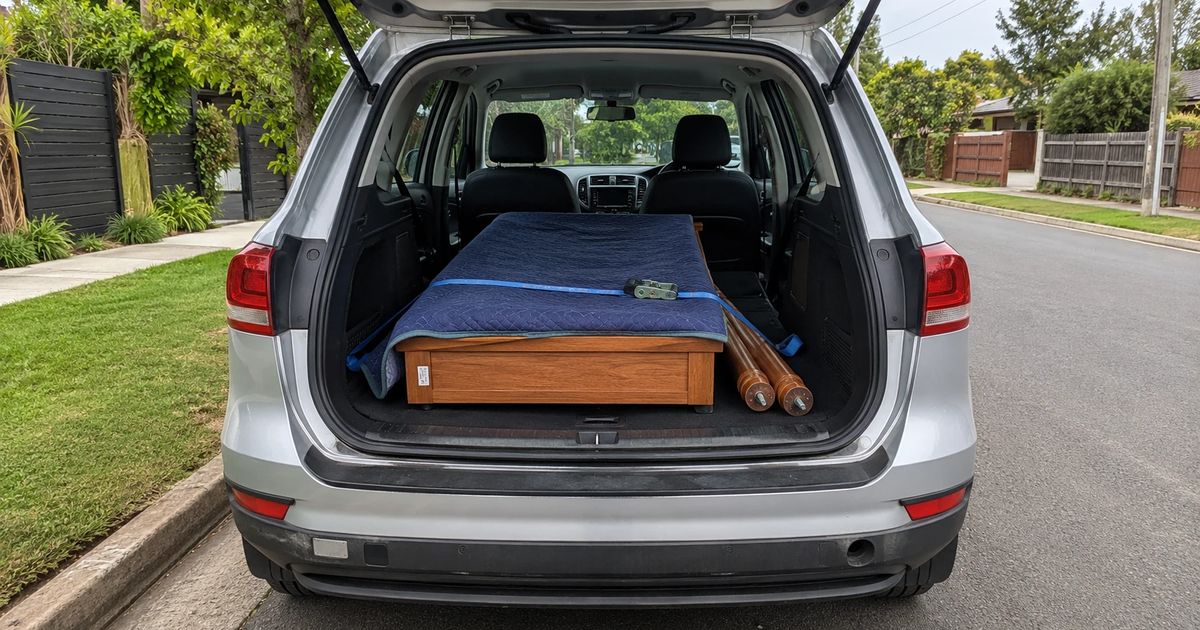
Line the entire boot floor, cover the rear seat backs if they are folded down, and wrap any sharp corners or metal feet before they touch your car. This takes five minutes and costs almost nothing.
Step 3 — Try it whole first, then dismantle
The instinct when something doesn't fit is to dismantle it completely. That is almost always more work than necessary.
The better approach: try loading it whole first. If it fits at the standard angle, great. If not, try it diagonally before reaching for a screwdriver.
If it still won't fit, partial dismantling is usually all you need:
Remove the legs — Most dining tables, coffee tables and sofas have legs that unscrew in under two minutes. Remove them and the main body drops 15–30cm in profile. It will often fit immediately.
Take off door panels — Sideboards, display cabinets and wardrobes with removable doors can be significantly reduced in weight and profile by detaching the doors first.
Unscrew shelves — Bookshelves and storage units often have adjustable shelving that lifts straight out. Remove the shelves, transport the carcass, put them back in when you get home.
IKEA and flat-pack furniture — These were designed to be disassembled. A few screws and most IKEA pieces are half their original size. Bring a basic screwdriver or an Allen key set.
The important thing to remember: you rarely need to fully dismantle anything. Removing two or three components is almost always enough. And reassembly at the other end takes five minutes.
Step 4 — Strap it properly and close the boot
Once the furniture is in, it needs to be secured so it doesn't shift in transit.
Ratchet straps are available at most hardware stores for approximately $12–20. They are the right tool for this job. Loop them around the furniture and attach to your boot tie-down hooks. Tighten until there is zero movement. Under Victoria's Road Safety (Vehicles) Regulations 2021, your load must be secured in a way that prevents it from shifting or falling — fines for unsecured loads start from $242.
Two tests before you drive:
- Push the furniture firmly forward and back — nothing should move
- The boot lid must close fully and latch properly — if it doesn't, the load is too tall or too long and needs to be repositioned
If your boot lid won't close fully with the furniture in, don't drive. Repositioning and rethinking is far better than losing a piece off the back of your car or getting pulled over.
If the piece is too large to fit with the boot closed even after partial dismantling, that is your signal that this one needs a van.
What fits in a regular car
As a general guide:
Usually fits in a hatchback, sedan or SUV with rear seats folded:
- Dining chairs (up to 4 stacked flat)
- Coffee tables (especially glass-top with removable legs)
- Side tables and bedside tables
- Small bookshelves and display shelves
- Lamps and floor lamps
- Ottomans and footstools
- Bar stools
- Small armchairs (tight but often possible)
Sometimes fits with partial dismantling:
- Two-seater sofas and loveseats
- Single bed frames (remove slats and headboard separately)
- Dining tables (with legs removed)
- Sideboards and buffets (with doors and shelves removed)
Rarely fits without a van:
- Three-seater sofas
- Queen or king bed frames
- Full wardrobes and large armoires
- Outdoor furniture sets
The best way to know is to measure — both the piece and your boot — before you commit. Most sellers are happy to provide measurements if you ask.
When to hire a man-with-a-van instead
For pieces that genuinely won't fit in a regular car, the most practical solution is a man-with-a-van service. In Melbourne, these typically start from around $50–80 for a short local job and can be found on platforms like Airtasker.
This is often the right call for:
- Three-seater and larger sofas
- Bed frames (queen, king)
- Large wardrobes and armoires
- Multiple pieces in a single pick-up
The cost of a man-with-a-van is almost always worth it compared to the cost of damaging your car, damaging the furniture, or injuring yourself trying to wrestle a wardrobe into a hatchback.
If you're buying multiple pieces from one seller, see if you can bundle the transport — one van trip for everything is more cost-effective than multiple car trips.
At Zirkly, every listing shows the seller's suburb. You can filter for pieces near you to keep transport simple — and most Melbourne sellers are flexible about pick-up timing.
List your furniture free on Zirkly
Got furniture you're not using? List it free on Zirkly and connect with local buyers in Melbourne. Listing takes under 10 seconds — just a photo and a price.
Frequently Asked Questions
Can I fit a sofa in a regular car?
A two-seater sofa or loveseat sometimes fits in a large SUV or station wagon with the rear seats folded, especially if the legs are removable. A three-seater sofa almost never fits in a regular car — this is when a man-with-a-van makes sense.
Do I need to fully dismantle furniture to transport it?
Rarely. Most pieces only need legs removed or a panel taken off to fit. Try loading the piece whole first, then diagonally, before reaching for a screwdriver. Partial dismantling is usually all that's required.
What do I use to protect my car boot from furniture damage?
A moving blanket or old doona laid across the boot floor and folded-down rear seats is enough for most pick-ups. Add cardboard for heavier pieces and pool noodles on sharp corners or metal feet.
Is it legal to drive with the boot open in Melbourne?
No. In Victoria, your load must be secured under the Road Safety (Vehicles) Regulations 2021 – REG 285, which requires loads to be secured in a way that prevents them from shifting or falling. Driving with an unsecured or improperly restrained load can result in fines starting from $242. If a piece is too large to close the boot fully, it needs to be transported differently — either partially dismantled until it fits, or via a van.
How do I ask the seller for measurements before pick-up?
Message them through the Zirkly app and ask for the overall length, width and height of the piece. Most sellers are happy to measure. Compare those dimensions against your boot measurements before you commit.
What is the easiest furniture to transport in a regular car?
Dining chairs, bedside tables, coffee tables with removable legs, bookshelves and lamps are the easiest. Anything with removable legs or modular components is ideal for car transport.
How do I find secondhand furniture close to me in Melbourne?
Browse listings by suburb at zirkly.com.au. Every listing shows the seller's location so you can find pieces within a few minutes of home — making car transport easy.
Adam
Zirkly Team
Adam focuses on turning complex secondhand furniture topics into practical, actionable advice for Melbourne buyers and sellers. He writes about used furniture pricing, buying guides, marketplace safety, and buying decisions, with a focus on the details that make buying and selling secondhand furniture clearer and more reliable. His guides are built for buyers and sellers who want clear answers, not jargon.