Art Deco Furniture in Australia: How to Identify 1930s Pieces
Not every Art Deco sideboard is from the 1930s, and not every one is Australian. Learn the shapes, materials and hardware to check, and how to tell period pieces from later Deco-style furniture.
Quick summary: Look for streamlined, geometric shapes, veneered surfaces, and hardware in chrome, glass or Bakelite. Australian pieces often use local timbers such as blackwood and Queensland maple. But a Deco look doesn’t prove a 1930s date, because later makers copied the style for decades. Treat age as something you build from several clues, and get a valuation before paying a premium for a rare maker.
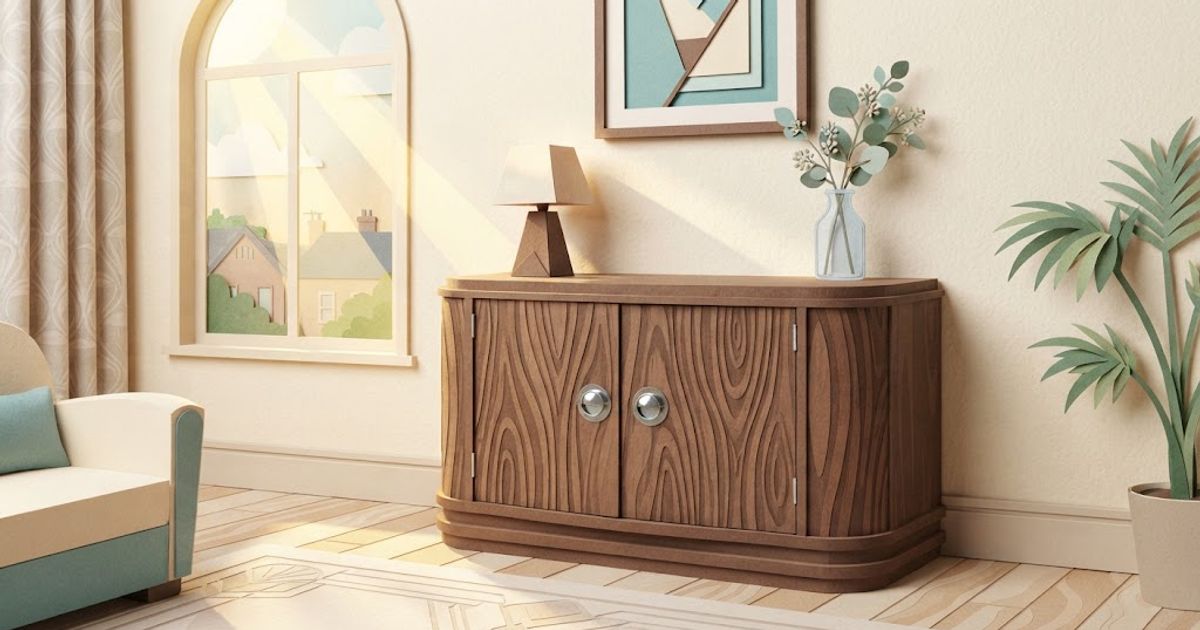
Art Deco furniture is easy to love and surprisingly easy to misread. A curved-front sideboard with chrome handles might be an original piece of Australian Art Deco furniture from the 1930s, a continental import or a much later Deco-style copy. This guide covers the shapes, materials, local timbers and hardware to look for, and how to distinguish period pieces from later reproductions. It’s useful for buyers and anyone selling an inherited piece in Melbourne.
What Makes Furniture “Art Deco”?
The name comes from a 1925 Paris exhibition of decorative arts. Carters describes the style as streamlined and geometric, with bright colours and new materials such as chrome, glass and Bakelite. It also notes that designers used rich materials like marble and rare woods. The same page says the period faded in the 1940s.
In practice, on a 1930s sideboard, wardrobe or cabinet, that usually means:
- Clean, symmetrical forms. Look for bowed or gently curved fronts, stepped profiles and solid plinth bases instead of ornate carved legs.
- Geometric detail. Examples include inlaid lines, parquetry panels and angular or circular pulls.
- Veneered surfaces. Matched, figured timber is laid over a cheaper carcase, with banding or contrast panels for effect.
- Modern hardware. Chrome or nickel-plated pulls and Bakelite handles replace the brass drop handles of earlier decades.
Australian Art Deco Furniture: Makers and Timbers
Australian makers often used local timbers, making timber identification a useful starting point when examining a possible Australian Art Deco piece. A Carters listing describes an Australian Art Deco pedestal from around 1930 in blackwood veneer with bands of fiddleback blackwood. Carters explains that fiddleback grain in Australia is found in blackwood, and that fiddleback was used on the finest furniture. Carters’ Art Deco sideboard listings also include a fiddleback Queensland maple sideboard from the 1930s.
The same category page has a Melbourne example. It is a sycamore-veneer sideboard by Edward Hill, with two doors and four drawers, original Bakelite and chrome handles, and measuring 93 x 187 x 54 cm. Carters gives no date for it, so don’t read it as a confirmed 1930s piece. It does show the combination to look for: local making, veneer and modern hardware. Most of the other Art Deco sideboards on that page are French or continental, so a Melbourne maker’s name is the exception, not the rule.
To tell the timbers apart, our guide to identifying Australian timbers in old furniture covers blackwood, Queensland maple and other species in more detail.
Early 1930s Melbourne design wasn’t all showy veneer. The National Gallery of Victoria holds a blackwood occasional table made around 1932 to a design by Fred Ward, attributed to the Fitzroy maker E. M. Vary. The NGV describes Ward as one of the first exponents of modernist design in Melbourne, and says he began designing and making furniture in 1930. It is a museum piece, not a typical sideboard. But it shows that local designers were working in local timber in this period.
How to Identify 1930s Art Deco Furniture
Work through the piece in this order. These checks are our own practical advice, not a formal dating standard.
1. Handles and hardware. Original Bakelite or chrome handles are a useful clue, though not proof of date on their own. Look for extra screw holes, mismatched finishes or handles that sit awkwardly, which suggest replacements. Carters points out that “Bakelite” is an umbrella term, and that the material came in many colours, not only dark brown.
2. Veneer. Carters notes that veneers have been machine cut and wafer-thin since the mid-19th century. So thin veneer doesn’t date a piece to the 1930s. What matters is how it’s used: matched grain, decorative banding and bold contrast panels.
3. Construction. Look inside. Drawer sides, backs and interior framing should look consistent with the age you’re being told. Cheaper softwood framing under veneer is normal, but fresh, bright timber inside a supposedly old piece is worth a question.
4. Wear that makes sense. Genuine age shows in the places hands and feet touch. Even wear on the front edges of drawers is more convincing than a uniformly distressed finish.
5. Overall form. A bowed front, a plinth base and geometric pulls are typical Deco features. But they are also easy to copy, so use them as supporting evidence only.
Is It Really 1930s, or Just Deco Style?
Plenty of furniture looks 1930s without being from that decade. The same Carters category page lists a macassar ebony sideboard in the Art Deco style made in Melbourne in the 1980s, and a macassar sideboard with Art Deco styling from around 1960. Both are labelled as later pieces. Carters also uses “circa” for age ranges and defines it as roughly five years either side of the stated year. So “circa 1935” really means about 1930 to 1940.
Three questions help:
- Do the materials and hardware agree with each other? Original handles on a worn carcase tell a consistent story.
- Does the maker or origin check out? A named maker, a label, a stamp or a family history all help.
- Is the asking price consistent with the evidence? A price that assumes a rare maker needs more than a Deco look to support it.
If the piece is ambitious in design, such as a large sideboard or a bedroom suite, a professional valuation is worth the cost before you buy or sell. If you’re comparing it with later Australian designs, our guide to Australian mid-century furniture by Fler, Featherston, Meadmore and Parker will help you tell the 1950s and 1960s apart from the 1930s.
Where Does the History Come From?
Be careful with sources. Auction and dealer catalogues, including Carters, are useful for seeing what has been sold and how it’s described. But they are descriptions written to sell, not research. For history, look to museum collections such as the NGV, which publish their own notes and attributions. There is no single Australian reference that dates 1930s furniture precisely. That’s why we’ve described these as clues instead of rules, and why a specific maker’s attribution deserves a source before you rely on it.
What Should You Do With a Piece You Can’t Date?
Photograph it well, including the underside, drawer interiors, any labels and the hardware. Measure it, note the timbers if you can, and write down what you know of its history. If it seems to be a good piece, ask an auction house or a valuer to look at it. If you’re selling, describe it honestly as “Art Deco style” or “circa 1930s” and say what you’re unsure of. Buyers of vintage furniture tend to trust sellers who state their uncertainty plainly.
Furniture from this period is also well suited to staying in use. Solid carcases, veneered fronts and metal hardware can be repaired and kept going, which keeps good pieces out of landfill.
Sell You Art Deco Furniture in Melbourne
Have an Art Deco sideboard, cabinet or bedroom piece to sell? List it on Zirkly with clear photographs, measurements and an honest description of its age and condition. Reach buyers across Melbourne looking for vintage and second-hand furniture.
Frequently Asked Questions
How can I tell if my furniture is Art Deco?
Look for streamlined, geometric forms, veneered surfaces and hardware in chrome, glass or Bakelite. Bowed fronts, plinth bases and inlaid or parquetry detail are common features. No single feature proves it, so use several together.
What Australian timbers were used in Art Deco furniture?
Australian pieces often use local timbers such as blackwood, including fiddleback figure, and Queensland maple and walnut. These appear in auction listings of Australian Art Deco pieces. Sycamore and other imported veneers also turn up.
Is Bakelite always brown?
No. It was made in several colours, including yellow, red, green and butterscotch, as well as brown. The word is also used loosely for several early plastics.
Does thin veneer mean a piece is from the 1930s?
No. Veneers have been machine cut and very thin since the mid-19th century, so thin veneer alone doesn’t date a piece. Look at how the veneer is laid and decorated, and whether the rest of the piece agrees.
What does “circa 1930s” mean on a listing?
“Circa” means about. The usual convention is five years either side of the stated year. A piece described as circa 1935 could date from roughly 1930 to 1940.
Are Art Deco-style pieces from the 1960s or 1980s worth less?
Not necessarily, but they’re a different category from period furniture. Price should reflect the evidence for the date. Descriptions such as “Art Deco style” or “in the manner of” signal that a piece is later.
Who can tell me if my piece is by a named maker?
Start with labels, stamps and family history, then ask an auction house or a valuer. A Deco look alone isn’t enough to attribute a piece to a named maker.
Can I sell Art Deco furniture in Melbourne without a valuation?
Yes. A valuation helps if you think the piece is rare or valuable, but it isn’t required. Describe the piece honestly, include clear photographs and state what you don’t know.
Erica
Zirkly Team
Erica covers interior styling, furniture trends and the vintage pieces worth knowing about, helping Melbourne buyers and sellers make secondhand furniture feel like a deliberate choice rather than a compromise.