Identify Australian Timbers in Old Furniture: Blackwood, Huon Pine, Jarrah and More
Learn how to identify Australian timber in old furniture by its colour, grain and figure. Discover the differences between blackwood, huon pine, jarrah, silky oak and Tasmanian oak.
Quick summary
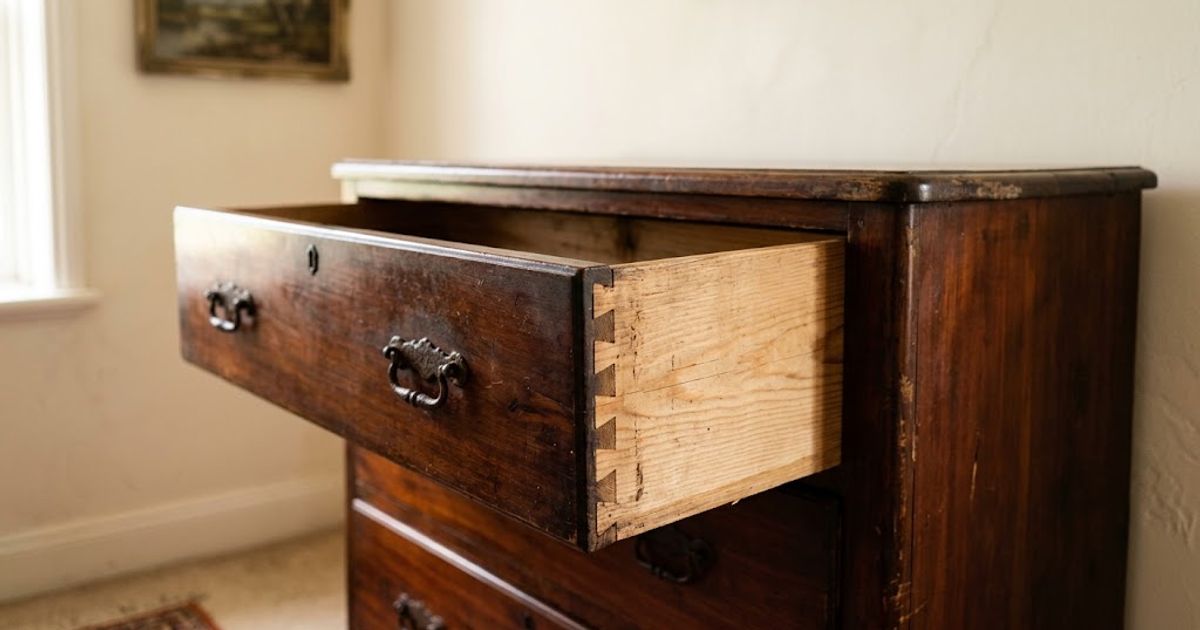
To identify Australian timber in old furniture, check unfinished surfaces such as drawer interiors and backs for colour, grain and figure, then compare what you see with the five timbers below. A visual match is a good guide, not proof, so say how sure you are when you buy or list.
Identifying Australian timber in old furniture starts with three clues: colour, grain and figure. Blackwood is often golden to dark brown with distinctive figuring, huon pine is typically pale gold with a fine grain, jarrah has dark red heartwood, silky oak shows a lace-like pattern, and Tasmanian oak is a trade name for several eucalypts. Because stains, finishes, veneers and similar-looking imported timbers can make identification difficult, treat visual clues as a guide rather than proof.
This guide is written for Melbourne buyers who want to know what they are looking at and sellers who want to describe a piece honestly. Our guide to vintage versus secondhand furniture mentions these timbers briefly; here each one gets its own entry.
How to Identify Australian Timber in Old Furniture
A finished surface can mislead. Stain, polish and decades of light all shift colour, so look where the timber was never finished:
- Check the underside of drawers, the back panel and the inside of cupboards, where raw timber shows its true colour and grain.
- Work out whether the piece is solid timber or veneer by looking at edges and drawer fronts. Highly figured timber is often used as a veneer over a plainer core.
- Note the figure: a wavy ripple (fiddleback), a lace-like fleck, or plain straight grain.
- Check the joinery and build with our guide to telling if secondhand furniture is good quality.
- Photograph a bare patch in daylight, because warm indoor lighting shifts colour in photos.
For pieces by named Australian makers, a maker’s mark can tell you more than the timber does. Our guide to Fler, Featherston, Meadmore and Parker furniture shows what to look for.
Blackwood: Golden Brown and Often Figured
Blackwood (Acacia melanoxylon) grows from around Adelaide through the eastern states as far north as Cairns, according to Carters Price Guide, an antiques price reference. Its colour runs from pale honey to dark chocolate with reddish streaks. Its wavy fiddleback figure can make it particularly sought-after in decorative furniture and veneers.
One caution: fiddleback is not exclusive to blackwood. Jarrah can show it too, as can some imported timbers, so a ripple in the grain narrows the field without settling it.
Huon Pine: Pale Gold and Fine-Grained
Huon pine is native to Tasmania. Carters describes a warm yellow, finely grained timber that was popular for household furniture in the Victorian era, and notes that a good deal of huon pine furniture was made in South Australia.
Colour is the trap. Stain can disguise it, and Carters’ own records include a Victorian huon pine dressing table finished with a mahogany stain. Look at bare timber inside drawers for the pale gold and tight, even grain before trusting the surface.
Is Huon Pine Protected in Tasmania? What the Government Says
Old catalogue notes often call huon pine a “protected species”, but that shorthand is loose. The Tasmanian Government’s Special Species Management Plan fact sheet lists huon pine among the prescribed “special species” timbers and states that none of those species is listed under Tasmanian or Australian threatened species legislation. In other words, huon pine is regulated, not listed as threatened.
Supply is still limited: the same fact sheet calls salvage timber from hydro storages a finite resource. The fact sheet covers harvesting special species timber, and rules can change, so it is not a ruling on selling finished furniture. The safest listing wording is “huon pine” plus how you know, not “protected”.
Jarrah: Dark Red From South-West Western Australia
Business Queensland says jarrah (Eucalyptus marginata) is confined to the south-west of Western Australia, so a jarrah piece in Melbourne used timber that travelled. It describes a dark red heartwood, usually darkening with exposure, with a pale yellow sapwood and a coarse, even texture. Wavy, interlocking grain sometimes produces a fiddleback figure.
Jarrah is listed for high-quality indoor furniture and for outdoor furniture, and it is termite resistant. A deep red-brown colour with a coarse grain points to jarrah; a pale, fine-grained piece does not.
Silky Oak: Lace-Like Flecking, Not an Oak
“Silky oak” is a name shared by more than one tree. Woodworking Network, quoting the Encyclopedia of Wood, explains that the name first applied to Grevillea robusta from southern Queensland and northern New South Wales, then extended to Cardwellia sublimis from north Queensland. Neither is a true oak.
Look for large rays that give a silvery, lace-like fleck in a pink to reddish-brown timber. “Lacewood” is a trade name that Australian silky oak sometimes goes by, but it is also used for similar-looking timbers such as Brazilian lacewood, so the fleck alone does not confirm Australian silky oak. The same 2011 article quotes a timber importer saying supply had become tight.
Tasmanian Oak: A Trade Name for Three Eucalypts
Business Queensland explains that Tasmanian oak is normally marketed as a mix of three eucalypts: mountain ash (also called Victorian ash), alpine ash and messmate. The heartwood is pale brown to white-brown, often with pinkish tints.
The name is a trade label, not a species, so it cannot tell you which of the three you have. Treat “Tasmanian oak” as shorthand for a pale Australian hardwood, not an exact identification.
Buying and Selling Timber-Identified Furniture in Melbourne
Be specific rather than certain. If you are selling, describe what you can see and what you know: “solid timber, believed to be jarrah, dark red with a coarse grain” is more trustworthy than a bare “jarrah”. Add photos of the grain, an unfinished underside and any maker’s mark. If you suspect a piece is a fine example, such as fiddleback veneer or early colonial work, our furniture valuation guide explains how to get it assessed.
If you are buying, ask the seller in chat for a photo of the back or the inside of a drawer, and ask whether the piece is solid or veneer. Browse the vintage category or a suburb page such as second hand furniture in Northcote to compare older timber pieces near you.
Once you can identify Australian timber in old furniture, it is easier to describe, price and match with the right buyer. List your piece free on Zirkly with photos of the grain and the unfinished underside, or browse older timber pieces from Melbourne sellers.
Frequently Asked Questions
How can I tell what timber my old furniture is made from?
Look at unfinished areas such as the underside of drawers, the back panel and cupboard interiors, then compare colour, grain and figure with the timber descriptions above. A visual match is a good guess, not proof. For a valuable piece, ask a specialist.
Is fiddleback always blackwood?
No. Fiddleback is a wavy figure, not a species. It is most associated with blackwood, but jarrah can show it too, and some imported timbers such as mahogany and maple do as well.
Is huon pine protected in Tasmania?
Older catalogue notes say so, but the Tasmanian Government’s special species fact sheet says none of the listed special species, including huon pine, is listed under Tasmanian or Australian threatened species legislation. Huon pine is regulated and in limited supply.
Where does jarrah come from, and what colour is it?
Jarrah is confined to the south-west of Western Australia. The heartwood is dark red and usually darkens with exposure, while the sapwood is pale yellow.
Is Australian silky oak the same as lacewood?
Not reliably. Lacewood is a trade name that Australian silky oak sometimes goes by, but it is also used for visually similar timbers such as Brazilian lacewood. It is not a species identification, so check what the seller means.
Is Tasmanian oak real oak?
No. It is a trade name for a mix of three eucalypts: mountain ash, alpine ash and messmate. It is usually a pale timber with pinkish tints.
Should I name the timber in my listing if I am not sure?
Yes, but say how sure you are. “Solid timber, believed to be blackwood” is more honest and more useful to buyers than a bare timber name. Photos of the grain and unfinished areas help buyers judge for themselves.
Where can I find older Australian timber furniture in Melbourne?
Browse the vintage category on Zirkly, or search a suburb page near you for chests of drawers, sideboards and tables. Message the seller to ask for photos of the back or inside a drawer before you go to inspect.
Erica
Zirkly Team
Erica covers interior styling, furniture trends and the vintage pieces worth knowing about, helping Melbourne buyers and sellers make secondhand furniture feel like a deliberate choice rather than a compromise.