Replica vs Original Designer Furniture in Australia: What’s Legal and How to Tell
Is replica furniture legal in Australia, and is your chair an original? How design protection works, what the Herman Miller case showed, and how to tell and list honestly.
Quick summary
Replica vs original designer furniture comes down to two questions: what the law allows and what the label says. In Australia, copying a furniture design that isn’t protected by a registered design right is often lawful, and buying a replica isn’t against the law. Other rules, including trade marks and misleading representations, can still apply, especially if a replica is presented as the original.
Last reviewed: 13 October 2026
If you own a chair that looks like a design classic, you probably have two questions. Is a copy even legal, and is yours the real thing? A replica isn’t automatically illegal, but “unregistered” doesn’t mean “free of any risk” either. The bigger danger for sellers is misleading a buyer about what a piece is. This post covers the general position, how to check your piece, and how to describe it honestly. It isn’t legal advice, and I’m not a lawyer.
Is replica furniture legal in Australia?
Two laws matter most, the Designs Act 2003 and the Copyright Act 1968. The Designs Act protects a product’s overall appearance, but only if the designer registers it. Copyright protects a designer’s original drawing automatically. For mass-produced furniture, though, the two interact in technical ways. The Conversation’s explainer on furniture copyright describes copyright as generally being lost once a design is industrially applied. It gives a common rule of thumb of 50 or more copies. Treat that as a simplification rather than a precise test.
The same explainer says copying designs that haven’t been registered in Australia is likely to be legal, and that nothing is illegal about buying a replica. It dates from 2018, so I checked it against IP Australia’s current guidance, which is consistent with it. IP Australia has consulted on changes to the designs system, but the proposals I found concern things like virtual and partial designs and simpler filing, not replicas.
“Likely legal” isn’t a guarantee. Trade marks, passing off and misleading claims about a product can all apply even where no registered design does.
How long does design protection last?
IP Australia says a registered design lasts up to ten years: five years from the application date, then one renewal for another five. A design must also be certified before the owner can enforce it. Australian design protection applies only in Australia.
A chair first made in the 1950s or 60s has almost certainly passed any registration window, or was never registered here at all. That is one reason so many replicas copy mid-century classics.
Original, licensed reproduction or replica?
These are practical labels for buyers and sellers, not legal definitions:
- Original: made by the designer or the authorised manufacturer, with evidence to support it.
- Licensed reproduction: made under licence from the rights holder, such as a later reissue. It is authentic but not necessarily vintage.
- Replica: a copy or lookalike that isn’t necessarily authorised.
- In the style of: a description of design features, not proof of authenticity.
For listings, the difference matters most between the first and third. Price and wording should match what you can actually show.
Can you sell replica furniture legally in Australia?
For businesses, legal commentary on replicas makes two consistent points. Check that no registered design applies, and don’t mislead buyers or infringe other rights such as trade marks. A business importing or selling replicas in volume should get proper advice.
For a private seller passing on a single piece, I found no source that addresses it directly. The safe approach is simple: describe the piece accurately, and say “replica” if it is one.
What the Herman Miller and Matt Blatt case showed
In 2011, Herman Miller announced a settlement with Tebi Pty Ltd, trading as Matt Blatt. The terms were confidential. The settlement resolved Herman Miller’s claim that the website misled the public about the authenticity of copies of Charles and Ray Eames designs, and infringed its intellectual property rights. Matt Blatt had publicly undertaken in 2006 to clearly identify its copies as replicas, and Herman Miller said it hadn’t done so in a number of instances.
The dispute wasn’t about replicas existing. It was about labelling. That case involved a retailer, not a private seller, but the principle carries over.
How to tell an original from a replica
Treat each of these as a clue, not a verdict. Labels can be transferred, and genuine vintage pieces often contain replacement parts.
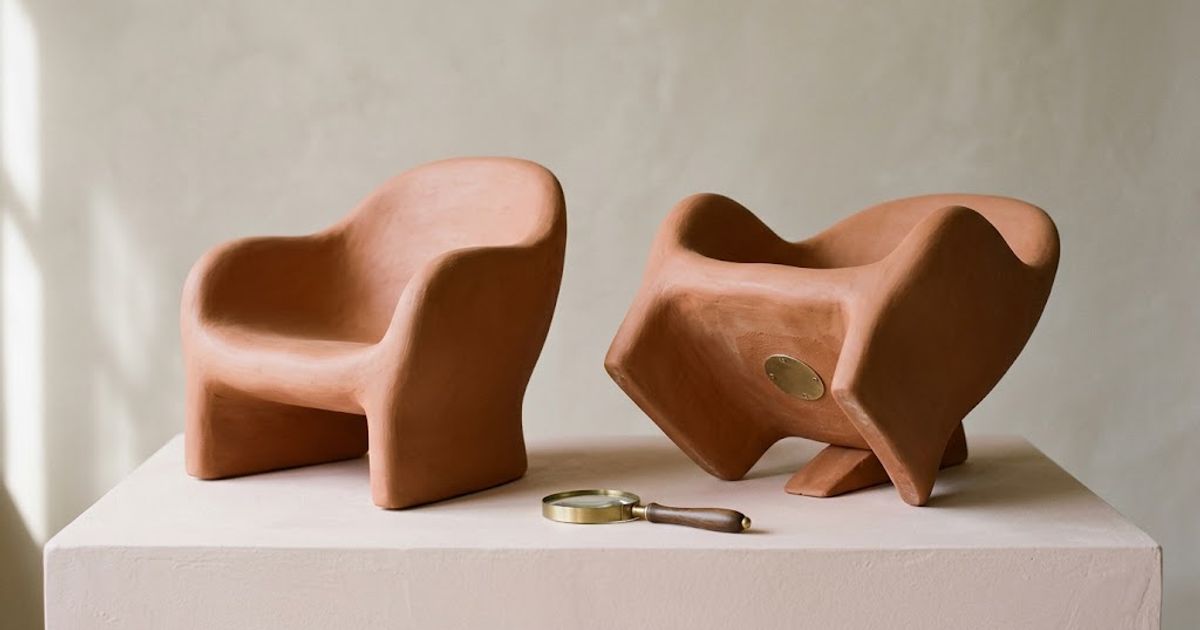
- Look underneath. Manufacturer labels, stamps and plates are usually on the underside or under the seat. Photograph them with a torch. Labels wear off, so a missing one doesn’t prove a replica, and a present one doesn’t prove an original.
- Match the piece to the maker. Many classics are made under licence. The Eames Lounge Chair, for example, comes from Herman Miller and Vitra. Makers publish guidance on recognising genuine pieces, so compare yours against it.
- Check the base and hardware. The Eames Institute’s Daniel Ostroff, speaking to Boing Boing, says collectors look for original bases. He treats a shiny screw in a base as suspicious and says era-correct leg glides help.
- Inspect shock mounts on moulded chairs. Marks suggesting a different base was fitted are worth noting.
- Watch for mixed-parts chairs. Ostroff warns about “FrankenEames”, built from parts of several chairs. A real shell on the wrong base isn’t fully original.
- Ask for provenance. A receipt, the original owner’s story or the retailer’s name all help.
If your piece might be Australian-made, the Zirkly guide to identifying Australian mid-century furniture covers Fler, Featherston, Meadmore and Parker marks. For the wider difference between vintage, retro and reproduction, see vintage vs secondhand furniture.
What to do if you can’t tell
Don’t guess in either direction. If you think you might own something valuable, a furniture valuation from an auction house or specialist dealer is the sensible next step. Send clear photos of the underside, the base, any labels and the joins. You can also contact the maker’s customer service.
If you can’t confirm it, say so in your listing. “Unverified, in the style of” is honest and still sells.
How to list a replica or an original honestly
- If it’s confirmed original: name the designer, maker and model only for what you’ve verified. Photograph the label and underside, and say if any parts are replacements.
- If it’s a replica: say “replica” clearly in the title. Don’t use the original designer’s name as if it were the product’s brand.
- If you’re unsure: describe the materials, shape and condition, and use “in the style of”. Avoid wording that claims more than you know.
A secondhand replica is still good secondhand furniture. It just needs to be priced and described as one. On Zirkly, buyers can message you through the app and ask for photos of the underside before they travel, which makes honest listings easier. If your piece is vintage, you can list it in the Vintage category.
Replica vs original designer furniture is a legal question first and an honesty question second. The law often allows copies, so the label you put on a piece matters more than most sellers realise.
Ready to pass on a chair, whether it’s an original or a replica? List it free on Zirkly with clear photos of the underside and an honest description.
Frequently Asked Questions
Is replica furniture legal in Australia?
Often yes, if no registered design applies, but “unregistered” doesn’t mean risk-free. Trade marks, passing off and misleading claims can still matter. Registered designs last up to ten years, and many classics are past that point.
Can replica furniture be sold legally in Australia?
Buying a replica isn’t illegal, and businesses can generally sell replicas of unprotected designs if they don’t mislead buyers or infringe other rights. For a private seller, the safe approach is to describe the piece accurately and say “replica” if it is one.
How long does design protection last in Australia?
Up to ten years: five years from the application date, plus one five-year renewal. The design also has to be certified before the owner can enforce it.
Can I sell a replica on Zirkly?
A secondhand replica is still secondhand furniture. List it with an honest description, with “replica” or “in the style of” in the title, and price it as a replica rather than an original.
How do I tell if my designer chair is an original?
Check the underside for maker labels, compare the piece with the maker’s own guidance, and inspect the base, screws and shock mounts. Treat each as a clue. Labels can be moved and genuine pieces can have replacement parts, so use several checks together.
Does a missing label mean my chair is a replica?
Not necessarily. Labels wear off over decades. A missing label means you need other evidence, such as the base, hardware, construction and any provenance.
Can I use the designer’s name in my listing?
Only for a piece you’ve confirmed is original. For a replica, say so clearly in the title and don’t present the name as the product’s brand. If you’re unsure, describe the piece by its shape and materials and say it is unverified.
Who can value my designer furniture in Melbourne?
Auction houses and specialist dealers can assess pieces from photos. Zirkly’s guide to furniture valuation in Melbourne covers antique, vintage and estate pieces and what to send.
Sujith
Zirkly Team
Sujith is the Founder of Zirkly, Melbourne's dedicated secondhand furniture marketplace. He writes about Melbourne's secondhand furniture market, consumer behaviour, and the circular economy, drawing on his experience building Zirkly and what helps furniture listings sell across Melbourne.