How to Write a Secondhand Furniture Listing That Actually Gets Replies
Most secondhand furniture listings get ignored — not because the price is wrong, but because the listing is. Here's exactly how to write a furniture listing in Melbourne that gets fast replies and sells.
Why most furniture listings get ignored
The pre-loved and secondhand goods market in Australia is now valued at $62 billion, up from $48 billion in 2021 — a 29 per cent spike in just two years, according to Gumtree's Trading in the Circular Economy report. That means there are more buyers than ever looking for secondhand furniture — and more sellers competing for their attention.
The difference between a listing that sells in 24 hours and one that sits for three weeks is almost never the price. It's the listing itself.
According to Forbes Advisor, Kelly Stephenson, Vice President of Brand and Communications at OfferUp, puts it directly: "Our most successful sellers treat their listings like a local storefront — they use clear, high-quality photos, write detailed and honest descriptions, and price competitively based on what similar items are going for." Most sellers skip at least one of those steps. This guide covers all of them.
The five elements every good listing needs
Before getting into the detail, here is the framework. Every secondhand furniture listing that consistently gets fast replies has five things:
1. A specific, searchable title — not "sofa" but "3-seater grey fabric sofa — solid timber legs — Bentleigh East"
2. A description that answers the buyer's questions before they have to ask — material, dimensions, age, condition, reason for selling
3. At least four photos — hero shot, second angle, close-up of condition, photo showing scale in the room
4. A price that reflects the market — not what you paid, not what you feel it's worth, but what comparable pieces are selling for right now
5. Accurate suburb and availability — buyers need to know where they're coming and when they can collect
Miss any one of these and you lose a meaningful portion of potential buyers before they even message you.
How to write a title that gets clicks
Your title is the single most important line in your listing. It determines whether a buyer even clicks through to see your photos and description. On most platforms, the title is all the buyer sees in the search results.
The formula for a high-performing furniture listing title:
[Quantity] + [Item] + [Key feature] + [Material or colour] + [Suburb]
Examples:
Solid oak 6-seater dining table + 6 chairs — Carnegie3-seater grey fabric sofa, timber legs, excellent condition — Bentleigh1960s teak sideboard, 3 drawers, original hardware — OrmondIKEA BILLY bookshelf white 80cm — like new — McKinnonElectric standing desk, motorised height adjust — Caulfield
What makes these titles work:
They are specific enough that a buyer searching for exactly this item will find it. "Sofa" returns thousands of results. "3-seater grey fabric sofa timber legs" returns a handful — and the buyers who search that phrase are specifically looking for what you have.
The suburb at the end matters for local platforms like Zirkly — buyers filter by location, and a suburb in the title confirms immediately that the piece is collectable without them having to read further.
What to avoid in titles:
- Vague descriptors: "nice", "beautiful", "great condition" — these add no searchable value and most buyers ignore them
- ALL CAPS — it reads as aggressive and looks like spam
- Excessive punctuation: "SOFA!!! MUST GO!!!" — signals desperation, invites lowball offers
- Missing the material: "dining table" tells a buyer almost nothing; "solid timber dining table" tells them everything that matters
How to write a description that converts browsers into buyers
Your description has one job: answer every question a buyer might have so thoroughly that the only logical next step is to message you to arrange pickup.
The information every furniture description needs:
Dimensions — always. Length, width, height. This is the most commonly missing detail in secondhand furniture listings and the most commonly asked question. Buyers need to know whether the piece fits in their space before they can commit. Give the dimensions upfront and you filter out time-wasters while attracting serious buyers immediately.
Material and construction. Solid timber, MDF, fabric type, leather grade, glass thickness. According to Forbes Advisor, proper imagery and detailed descriptions dramatically impact both interest and final sale prices. Material is the detail that justifies your price and attracts the right buyer. "Solid oak" means something. "Timber-look" means something very different.
Age and provenance. When was it bought? Where was it bought from? A piece bought from a quality furniture retailer five years ago holds more value than a similar piece from a discount store. If you know the brand, include it.
Condition — honestly. Describe what the piece actually looks like. Minor scuffs, small scratches, slight fading — describe them and buyers who see it in person will trust you. Omit them and buyers who drive across Melbourne to inspect it will walk away frustrated, having wasted both your time. As Cash Converters Australia puts it, buyers will pick up on the true value of your product just as much as you know its true condition — you also want to show people that you're an honest and trustworthy seller.
Reason for selling. "Moving interstate", "upgrading", "no longer fits the space" — a brief reason humanises the listing and reduces buyer suspicion. It doesn't need to be long. One sentence.
Availability and pickup. What days and times can the buyer collect? Do they need a van? Will you help carry it down stairs? Logistics clarity removes friction.
The description template:
[Item name], [material], [dimensions: L x W x H cm]. Bought from [retailer] approximately [X] years ago. [Condition description — honest]. [Any known issues disclosed here.] Reason for selling: [one line]. Available for pickup from [suburb] on [days/times]. [Van/car info if relevant].
Keep it under 150 words. Buyers don't read essays — they scan for the dimensions, material, and condition. Put those first.
How to photograph your listing for maximum impact
According to Secondhand Chairs and Tables, a customer will base 90 per cent of their purchasing decision on the first photograph they see. Every other element of your listing supports the photos — it does not replace them.
The four photos every furniture listing needs:
Photo 1 — The hero shot. The whole piece, in natural light, from a slight angle so both the front and one side are visible. This is the photo that shows in search results. It needs to show the piece clearly with no clutter in the background. Natural daylight — never flash.
Photo 2 — The second angle. From the opposite side or directly from the front. For sideboards, bookshelves, and storage pieces, include a photo with drawers or doors open.
Photo 3 — Close-up of the surface and condition. The tabletop, the upholstery, the timber grain. This is where honest condition disclosure lives. If there's a scratch, photograph it here — it builds trust and filters out buyers who would walk away on inspection anyway.
Photo 4 — Scale in context. The piece in your room, showing how it sits relative to walls and other furniture. Buyers struggle to visualise dimensions in isolation. A photo showing the sofa next to a standard door or the dining table in a dining room gives an immediate sense of scale that a list of measurements can't fully convey.
Practical photography tips:
- Shoot in the morning or afternoon with natural light from a window — avoid harsh midday sun and never use flash
- Clear everything off and out of the piece — empty shelves, remove cushions and style them back cleanly, clear the floor immediately around it
- Shoot from a standing height, slightly angled down — not from the floor looking up and not from the ceiling looking straight down
- For sofas and upholstered pieces, fluff the cushions and smooth the fabric before every shot
- A plain wall as a background makes the piece the focus — not the rest of your apartment
We've covered photography in detail in our guide: How to Photograph Secondhand Furniture to Sell Fast.
Pricing — how to set a number that gets replies without leaving money on the table
According to Forbes Advisor, a good rule of thumb is to list at 60 to 70 per cent of the current retail value, and further lower the price if the piece has visible damage or wear.
But the most reliable pricing method is not a formula — it's comparable listings. Search for the same piece on Zirkly in Melbourne right now. Find five to ten similar listings in similar condition. The cluster of prices in the middle is your market value.
The three pricing strategies:
Fast sale: price 10 to 15 per cent below the middle comparable — gets multiple enquiries in the first 24 hours, sells within a week, slight trade-off on final price.
Fair sale: price at the middle comparable — the right approach for most pieces. Expect to sell within one to three weeks with good photos and a complete description.
Patient sale: price 10 per cent above the middle comparable — only works for solid timber, quality brand, or genuinely excellent condition pieces. Be prepared to wait three to four weeks and drop the price if nothing moves.
Round numbers perform better. $250 is easier to process than $265. Rounded prices look considered. Odd prices like $185 or $340 look like you've calculated a depreciation and they invite negotiation on the specific number rather than the approximate value.
We've covered pricing in full detail in our guide: How to Price Secondhand Furniture in Melbourne.
The negotiation question — should you put ONO?
ONO — "or nearest offer" — signals to buyers that you're open to negotiation, which increases the number of people who message you. More messages means faster sales even if the final price is slightly lower.
According to Forbes Advisor, experienced reseller David advises: "Bake 10 to 15 per cent into the asking price. Buyers will counter at least once on these sites, so assume that. Decide on your floor before you list and stick to it — if you receive a bid 40 per cent below asking, counter your floor and continue the negotiation. You get more business from a polite counter than a walkout."
The practical approach: add ONO if you have flexibility and want to maximise enquiry volume. Don't add ONO if you have a firm price and don't want to negotiate — but be aware that buyers will often try anyway.
What to avoid: "firm price, no offers." This phrasing consistently reduces enquiry volume because it reads as inflexible and unwelcoming, even to buyers who would have paid your asking price.
Common listing mistakes that kill sales
No dimensions. The most common reason a buyer doesn't message is that they can't confirm the piece will fit their space. Always include length, width, and height.
Only one photo. One photo forces the buyer to ask for more before they can decide. More questions before a decision means lower conversion. Give them everything they need upfront.
Vague condition description. "Good condition" means nothing without context. "Good condition — minor scuff on the right rear leg, all joints solid, no stains" means everything. Be specific.
Price way above market. Buyers in Melbourne check comparable listings before messaging. If your price is significantly above comparable pieces, your listing gets skipped entirely — buyers don't message to negotiate down from an unrealistic price, they just move on.
Ignoring messages. Response speed matters. Buyers who message on a Friday evening and don't hear back until Monday morning have often already found another piece. Reply within a few hours when possible.
Listing at the wrong time. A listing published on Monday morning has low traffic until the weekend. Publish Thursday or Friday evening to catch the peak weekend browsing window. We covered timing in detail in our guide: Best Time to Sell Secondhand Furniture in Melbourne.
Forgetting to refresh stale listings. If your listing hasn't had enquiries in two weeks, update at least one photo and edit the description slightly. Most platforms treat an edited listing as a refreshed listing, pushing it back toward the top of search results.
A complete listing example — before and after
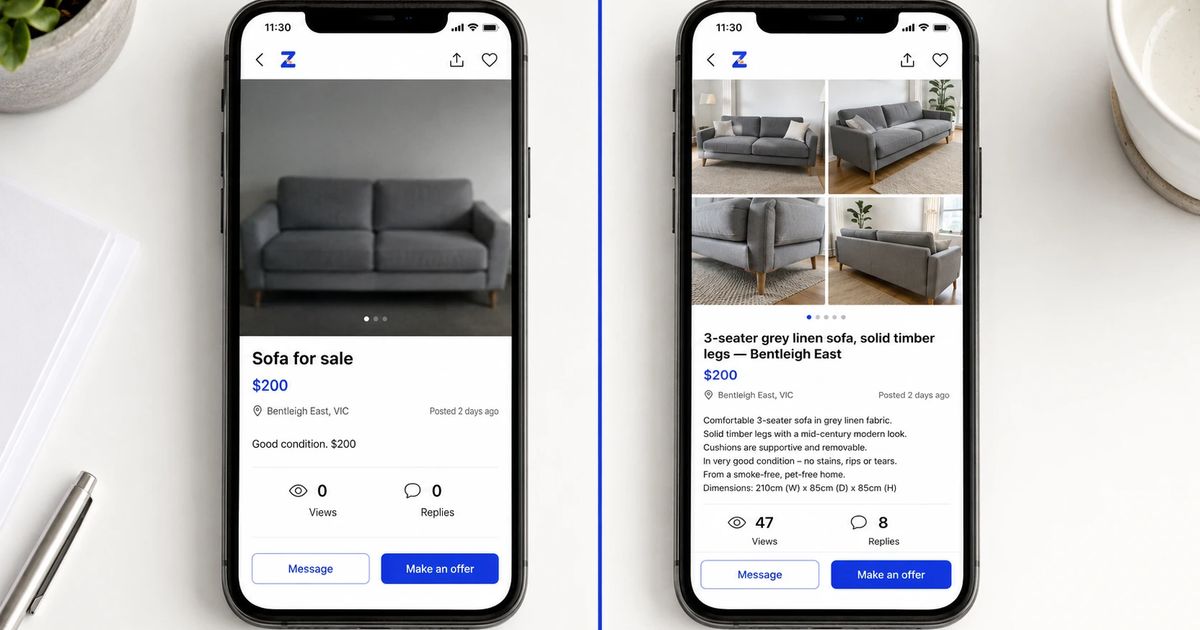
Before — a listing that gets ignored
Title: Sofa for sale
Description: Good condition sofa. Grey. Selling because moving. $200 ono.
Photos: One photo, dark room, taken from across the room.
After — a listing that gets replies
Title: 3-seater grey fabric sofa, solid timber legs, excellent condition — Bentleigh East
Description: 3-seater sofa, grey linen fabric, solid timber tapered legs. 220cm L x 90cm D x 85cm H.
Bought from Nick Scali approximately 3 years ago. Excellent condition — fabric is clean with no stains or pet hair, all cushions firm, timber legs solid with no wobble. Minor scuff on the underside of the right rear leg, not visible when in use.
Selling because we've upgraded to a larger sofa.
Available for pickup from Bentleigh East. Fits in a large SUV with rear seats folded — legs are removable.
Photos: Hero shot in natural light from a 45-degree angle. Second shot from the front. Close-up of the fabric texture and one scuffed leg. Wide shot in the living room showing scale against the wall and a standard door.
Price: $280
The second listing answers every question before the buyer has to ask. It will generate multiple enquiries. The first listing generates one question — "what are the dimensions?" — which kills momentum before the sale even starts.
List your furniture free on Zirkly
Write a great listing and post it free on Zirkly — Melbourne's dedicated secondhand furniture marketplace. Every listing reaches local buyers in your suburb who are ready to collect this week.
Frequently Asked Questions
What should I include in a secondhand furniture listing?
Every furniture listing needs five things: a specific searchable title including material and suburb, dimensions (length, width, height), an honest condition description, at least four photos including a hero shot and a scale-in-context photo, and a market-based price. Missing dimensions is the single most common reason a buyer doesn't message — always include them.
How do I write a good title for a secondhand furniture listing?
Use the formula: item + key feature + material or colour + suburb. For example: "Solid oak 6-seater dining table + 6 chairs — Carnegie" or "3-seater grey fabric sofa, timber legs — Bentleigh." Specific titles appear in more search results and attract buyers who are looking for exactly what you have.
How many photos should I include in a furniture listing?
A minimum of four: a hero shot from a slight angle in natural light, a second angle, a close-up of the surface and any condition issues, and a wide shot showing the piece in the room for scale. More photos are better. Listings with multiple high-quality photos consistently sell faster and for better prices than single-photo listings.
Should I put ONO (or nearest offer) in my furniture listing?
Yes, if you have flexibility on price. ONO increases the number of buyers who message you, which leads to faster sales. Build 10 to 15 per cent negotiating room into your asking price so you can meet buyers in the middle without going below your floor price. If you have a firm price and don't want to negotiate, omit ONO — but expect that buyers will still try.
Why is my secondhand furniture listing not getting replies?
The most common reasons are: missing dimensions, only one photo, a vague or dishonest condition description, price significantly above comparable listings, or a listing published at a low-traffic time. Try updating at least one photo, adding dimensions if missing, and republishing on a Thursday or Friday evening to catch the weekend browsing peak.
How do I price secondhand furniture to get fast replies?
Search for five to ten comparable pieces currently listed in Melbourne. Find the cluster of prices in the middle — that is your market value. Price at the middle for a fair sale, 10 to 15 per cent below for a fast sale. A good rule of thumb is 60 to 70 per cent of current retail value for a piece in good condition, lower for visible damage or wear. Our full pricing guide is at How to Price Secondhand Furniture in Melbourne.
What is the best platform to sell secondhand furniture in Melbourne?
Zirkly is Melbourne's dedicated secondhand furniture marketplace — every listing is furniture-only, every seller is local, and buyers search specifically for furniture rather than scrolling through general classifieds. Because buyers on Zirkly are already in a furniture-specific mindset, listings reach higher-intent buyers and sell faster than on general platforms.
How long does it take to sell secondhand furniture in Melbourne?
A well-written listing with good photos, accurate dimensions, honest condition disclosure, and a market-based price typically sells within one to three weeks in Melbourne. In peak season (January to March and June to July), well-priced pieces in good condition can sell within 24 to 48 hours. If a listing hasn't moved in two weeks, refresh the photos and description before adjusting the price.
Erica
Zirkly Team
Erica explores the relationship between furniture, interiors, and everyday living in Melbourne and beyond. She writes about sustainable interiors, secondhand furniture, vintage design, and interior trends, with a focus on making thoughtful design choices more approachable. Her perspective combines an appreciation for timeless pieces with a belief that the most meaningful spaces are built around furniture with history and character.