What to Consider Before Buying Secondhand Furniture — Will It Fit Your Home and Your Life?
Before you fall in love with a piece of secondhand furniture, check these things first. A Melbourne buyer's guide to dimensions, style, lifestyle fit, transport and total cost — so nothing gets left on the kerb.
The most common secondhand furniture mistake — and how to avoid it
The most common mistake in buying secondhand furniture is not buying something with bed bugs or a wobbly leg. It is buying something that does not fit — the wrong dimensions for the room, the wrong style for the home, the wrong size for the doorway, or the wrong piece for how you actually live.
According to Cedora's furniture buying guide, if it does not fit, it is not a bargain. The measurement check, the doorway check and the room flow check must come before anything else — before photos, before price, before the seller's story about where it came from.
This guide covers everything to consider before you commit to buying second hand furniture in Melbourne — not just whether the piece is good quality, but whether it is right for your space and your life.
Before buying secondhand furniture, check these seven things:
- Dimensions — room, doorway, stairwell, lift
- Lifestyle fit — suits how you actually use the space
- Style compatibility — works with what you already own
- Total cost of ownership — price plus cleaning, repairs and transport
- Transport — can you get it home, and how?
- Safety — no recalls, no structural failure, no hazardous materials
- Online vs in-person — what you can confirm remotely vs what requires inspection
| Check | What to confirm |
|---|---|
| Dimensions | Fits the room, the doorway, the stairwell, the lift |
| Lifestyle fit | Suits how you actually use the space |
| Style | Works with what you already own |
| Total cost | Price + cleaning + repairs + transport |
| Transport | Can you get it home, and how? |
| Safety | No recalls, no hazardous materials, no structural failure |
What you can check online vs what requires an in-person inspection:
| Consideration | Check online? | Requires inspection? |
|---|---|---|
| Dimensions | ✓ — ask seller for exact measurements | — |
| Style and colour | ✓ — photos, video call | ✓ — undertones, visual weight |
| Listing price | ✓ | — |
| Smell | — | ✓ — smoke, pet, damp |
| Structural stability | — | ✓ — wobble test, push test |
| Drawer and door movement | — | ✓ — open every drawer |
| Material (solid timber vs MDF) | Partial — ask seller | ✓ — tap test, edge check |
| Colour accuracy | Partial — photos vary by lighting | ✓ — compare in person |
Measure first — dimensions, doorways and room flow
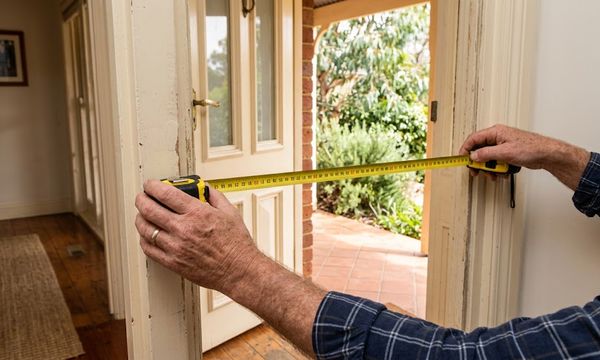
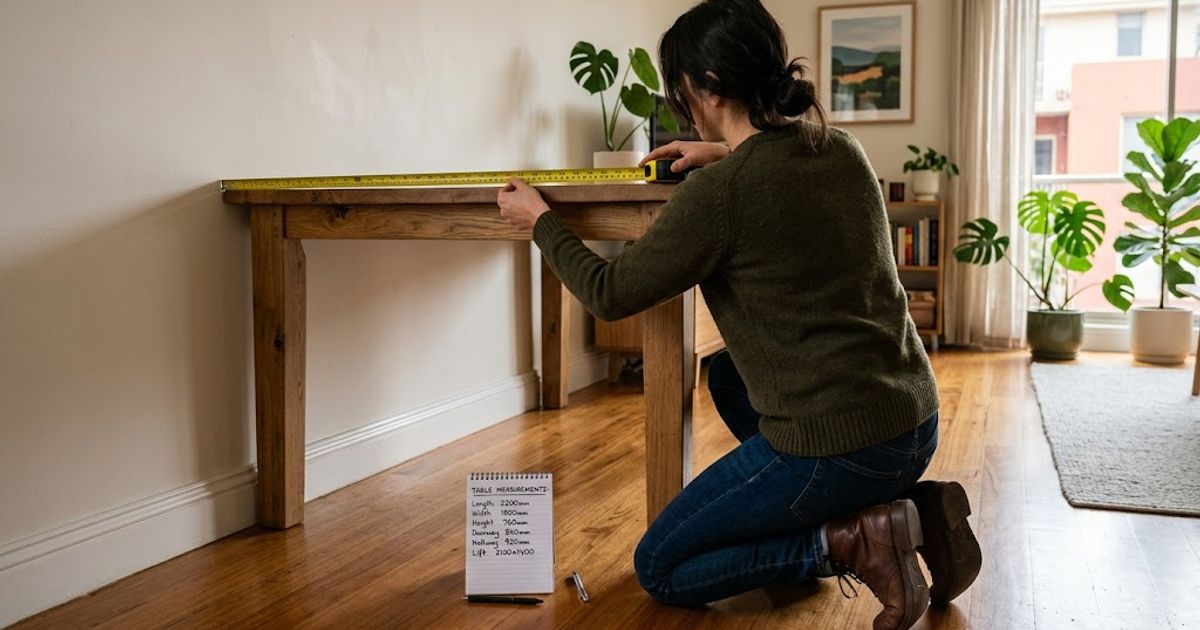
Before browsing any used furniture listing, measure your space. Before inspecting any piece, measure the piece. Before agreeing to collect, measure the doorways, stairwell and lift.
According to YourLifeChoices' Australian secondhand furniture guide, creating a simple inspection kit — a tape measure, phone torch, notepad and disinfectant wipes — prevents the disappointment of falling in love with pieces that will not fit through doorways or suit your room.
Measure your space first
Before you start browsing secondhand furniture in Melbourne, write down:
- The wall length where the piece will sit
- The maximum depth you can allow (the distance from wall to the nearest walkway)
- The ceiling height (relevant for wardrobes, bookshelves and tall sideboards)
- Any fixed obstacles — power points, light switches, skirting boards, bay windows
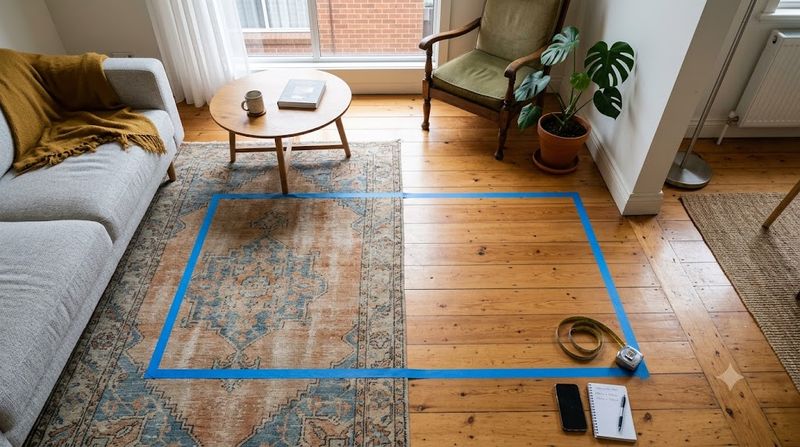
A common mistake identified by Cedora is buying a sofa that technically fits the wall but leaves no easy path through the room. Two practical tricks: use painter's tape on the floor to map out furniture footprints before buying, and always leave enough clearance for doors, drawers and walking paths.
Measure the piece
When you find a listing you like, ask the seller for exact dimensions — height, width and depth — before arranging an inspection. If the seller doesn't know, ask for a photo next to something with known dimensions (a standard door is 2040mm high; a standard ceiling is 2400mm high in most Melbourne apartments).
According to Cedora's furniture buying guide, always consider height, width and depth — not only to ensure pieces fit through your home's doors, but also to make sure you can comfortably use your existing furniture alongside the new piece.
Measure the access route
This is the check that ruins more secondhand furniture purchases in Melbourne than any other.
Measure in this order:
- The front door or building entrance (width and height)
- Any hallway the piece must travel through (width and any tight corners)
- Any stairwell (width, height and whether the piece can be tilted on its side)
- Any lift (internal dimensions — in many Melbourne apartment buildings, the lift is the binding constraint)
- The door to the final room
A piece that fits your living room perfectly but cannot navigate the 850mm-wide hallway of your Brunswick apartment is not a piece you can buy. Confirm access before you travel.
Does it match your lifestyle, not just your aesthetic?
A pre-owned piece that looks right in the seller's home may not work in yours — not because of dimensions, but because of how you actually live.
According to Creating Positive Spaces' furniture buying guide, a useful question to ask before any furniture purchase is: what problem am I trying to solve? This helps you buy with purpose rather than just because something looks good or seems like the right thing to do.
Questions to answer before committing to any secondhand piece:
How do you use this room? A dining table that seats six looks generous in a listing photo — but if you live alone and eat at your desk four nights a week, a six-seater dining table is furniture you will clean around and move around, not furniture you will use. Be honest about your actual behaviour, not your ideal behaviour.
Who uses the furniture? According to YourLifeChoices, for buyers with mobility considerations, comfort factors become important beyond aesthetics — seat heights that are too low can be difficult to rise from, while tables should be at a comfortable height for daily activities. Test seat heights and comfort in person.
How long will you be in this space? Melbourne renters moving frequently need furniture that is easy to move, disassemble and store. A heavy solid timber wardrobe is excellent value for an owner-occupier — it is a logistical problem for a renter who moves every 12 months. Buy for the space you are in, not the home you might one day have.
Do you have pets or children? Light-coloured upholstery in a home with a dog, or a glass coffee table in a home with toddlers, creates friction from day one. The secondhand market has enormous choice — be specific about what your household actually needs.
How much maintenance are you willing to do? Solid timber furniture with a natural oil finish requires periodic re-oiling to stay in good condition. Upholstered pieces need regular vacuuming and occasional professional cleaning. A piece that requires maintenance you won't do will deteriorate faster than its quality warrants.
Style and colour — how to check if it fits what you already own
Style compatibility is easier to assess than most buyers expect — and easier to get wrong than it looks in a listing photo.
According to Reval's furniture buying guide, choosing three colours — a main colour, a secondary colour and an accent — is one of the simplest methods to colour-coordinate furniture. The 60-30-10 rule used by interior designers achieves balance: 60% dominant colour, 30% secondary, 10% accent.
Practical checks before buying:
Take a photo of your existing room. Before inspecting any piece, take a wide-angle photo of the room it will live in. Use this as a reference when you're at the seller's home — compare the material, tone and scale of the piece against what you already have.
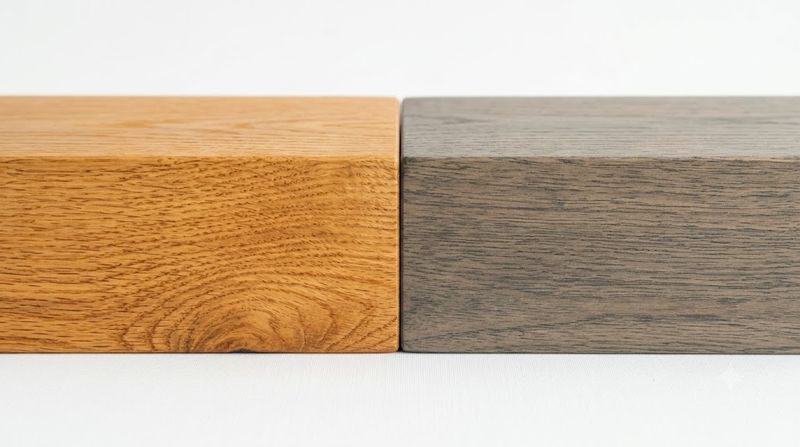
Check undertones, not just colours. A "grey" sofa can be warm grey (beige undertone) or cool grey (blue undertone). A "timber" table can be honey, red-brown or grey-brown. Undertones that clash are more jarring than different colours that share a warm or cool base. Take a cushion or throw from your existing room to compare in person.
Consider visual weight. According to Creating Positive Spaces, a bulky piece can overpower a small room, and a tiny piece can look lost in a larger space. Proportions and visual weight matter as much as dimensions. A solid dark timber sideboard in a small light room changes the whole atmosphere — in ways that are hard to predict from a photo.
Check style consistency. A piece that is heavily ornate in a minimal interior, or aggressively industrial in a coastal home, will always feel wrong even if the dimensions are perfect. Style coherence is not about everything matching — it is about pieces that share enough in common to feel intentional together.
Four practical visual checks that make a real difference:
- Photograph your room at the same time of day you'll be inspecting. Lighting changes dramatically through a Melbourne day — a piece that looks warm in morning light may read differently in the afternoon. Taking your reference photo in similar conditions to the inspection gives you a more accurate comparison.
- Compare timber undertones using something you already own. Bring a small item — a book, a cushion, a cutting board — with a timber or colour tone you want to match. Hold it next to the piece at inspection. Your eye will immediately tell you if the undertones work together.
- Step back 3 to 4 metres to judge visual weight. When you're standing close to a piece of furniture, it always looks smaller than it will in your room. Step back to a distance roughly equivalent to where you'd normally be in your space and assess the piece from there.
- Use your phone to mock up the piece in your room. Place the listing image into a photo of your room using your phone's edit tool or a free app. It won't be perfect, but it gives you a far better sense of scale and proportion than imagining it.
💡 Zirkly tip: Ask the seller to video-call or send a short video of the piece in its current room context. Seeing a used sofa or pre-owned dining table in someone else's actual home gives you a far better sense of scale and atmosphere than photos alone.
Total cost of ownership — price is not just the asking price
The asking price of a used sofa, dining table or bed frame is only one component of what it will actually cost you.
According to YourLifeChoices, it is important to set realistic spending limits before you start browsing and to consider the total cost of ownership — factoring in potential cleaning, repairs or modifications. A $100 dining table that needs $50 worth of refinishing may be a reasonable buy. One that needs $150 in repairs before it is usable may not be better value than a $120 ready-to-use alternative.
The full cost to calculate before buying:
Asking price — what you pay the seller.
Cleaning costs — upholstered pieces may need professional steam cleaning ($80–$150 for a sofa). Timber pieces may need a re-oil or wax treatment ($20–$40 in materials, or $80–$120 for a professional). Our upcycling guide covers exactly what DIY maintenance costs and what it achieves.
Repair costs — a wobbly joint can be re-glued for under $10 in materials. Replacing drawer runners costs $15–$30. Re-upholstering a dining chair seat costs $30–$80 per chair. A full sofa re-upholster is $600–$2,000 depending on complexity — usually not worth it unless the frame is exceptional.
Hardware replacement — new handles and knobs from Bunnings cost $15–$40 for a set. Worth factoring in if the existing hardware is dated or damaged.
Transport costs — see the section below. This is where many buyers are surprised.
The check: add these costs to the asking price before comparing against new alternatives. A $180 secondhand solid timber dining table that needs a $40 re-oil is a $220 piece — and almost certainly better value than a $450 new MDF alternative. A $150 secondhand sofa that needs $300 in professional cleaning and $200 in transport is a $650 piece — and the comparison changes significantly.
Transport and logistics — the Melbourne reality
Transport is the most underestimated cost and complication when buying used furniture in Melbourne — particularly in Melbourne, where apartment density, narrow staircases and lift constraints create real logistical challenges.
Check these before you commit:
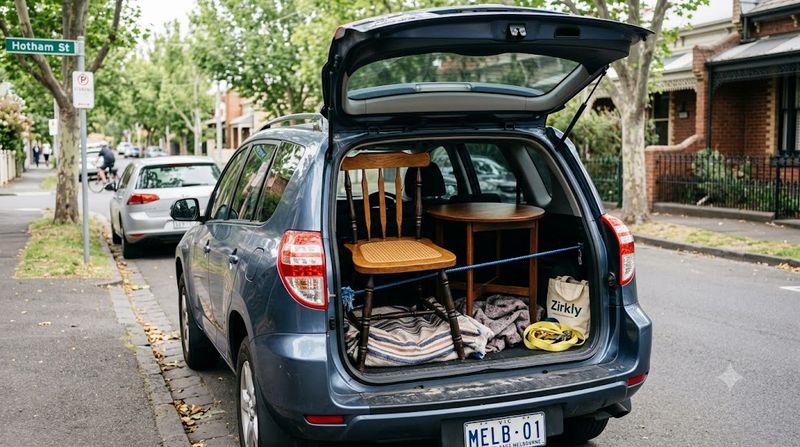
Does it fit in your car? Our guide to transporting furniture in a regular car covers what fits in which vehicle types and how to secure pieces safely. Most mid-size furniture — dining chairs, side tables, bookshelves — fits in a standard SUV or station wagon with seats folded. Large sofas, king bed frames and tall wardrobes generally do not.
Can it be disassembled? Many solid timber pieces — dining tables, wardrobes, bed frames — can be disassembled for transport and reassembled at home. Ask the seller before you travel. If legs, shelves or panels can be removed, transport becomes significantly easier. If the piece is constructed in a way that doesn't allow disassembly (particularly glued or fixed-joint pieces), factor in the additional transport requirements.
What does the access look like at both ends? Confirm the access situation at the seller's property (stairs, lifts, parking, distance to carry) and at your property (hallway width, stairwell dimensions, lift size). Melbourne apartment buildings vary enormously — a piece that fits easily into a house in Ormond may require two people, a trolley and twenty minutes of careful manoeuvring in a South Yarra apartment building.
Transport options and typical Melbourne costs:
- Personal vehicle: free, but limited by boot size. Best for small to medium pieces.
- GoGet or car share van hire: $15–$40 per hour including fuel. Good for medium pieces with flexible timing.
- Airtasker furniture delivery: typically $60–$150 for a single large piece within Melbourne, depending on distance and complexity.
- Professional furniture removalist (two people, truck): $150–$300 for a single pickup and delivery within Melbourne. Worth considering for very large or heavy pieces.
The rule: a solid timber dining table at $150 is a genuine bargain if you can move it yourself or with a friend. It becomes a much more marginal decision if it requires a $120 Airtasker job to get home. Factor transport into your price comparison before you commit.
Safety and material considerations
Two safety checks worth making before any secondhand furniture purchase.
Check for recalls. The ACCC Product Safety website maintains a searchable database of all consumer product recalls in Australia. Before buying any named-brand secondhand furniture, search the product or brand name — recalled pieces can present genuine safety hazards that are not visible during a standard inspection. The search takes under a minute and is worth doing for any piece with a recognisable brand or model name.
Check for hazardous materials. According to the ACCC's product safety guidance, consumers should be aware that older furniture may contain materials that no longer meet Australian safety standards. Lead-based paint is one of the most common — it was used in furniture manufactured before the 1970s and was banned in Australian consumer products in 1997. Pieces from that era with chipped or flaking paint, particularly in homes with young children, warrant extra caution.
Check for structural safety. A piece that wobbles, has cracked structural components, or has joints that have failed is not merely a cosmetic problem — it is a safety risk, particularly for chairs, bed frames and bookshelves that carry weight. Our quality inspection guide covers structural checks in full.
The pre-purchase checklist — what to ask before you travel
Before you arrange an inspection or commit to a pickup, message the seller with these questions. They save time, prevent wasted trips and give you the information you need to make a confident decision.
Dimensions and fit:
- What are the exact dimensions — height, width, depth?
- Can it be disassembled for transport?
- How heavy is it approximately?
Condition:
- Can you send a photo of the underside or back panel?
- Can you send a photo of one drawer corner (pulled fully out)?
- Is there any wobble, sticking or odour?
- Has it had any repairs?
History:
- Where did it come from originally?
- How old is it approximately?
- Has it been in a home with pets or smokers?
Logistics:
- Is there parking nearby?
- Are there stairs at your end?
- When are you available for pickup?
Before you buy — your final checklist:
✓ Measured the room, the piece and every access point on the route home ✓ Confirmed it suits how you actually live — not just how you'd like to live ✓ Checked style and undertones against what you already own ✓ Calculated the true total cost — asking price plus cleaning, repairs and transport ✓ Confirmed transport logistics before committing ✓ Checked for recalls and structural safety ✓ Asked the seller the right questions before travelling
Ready to find a piece that fits your home and your life? Browse secondhand furniture in Melbourne — every listing is local, every seller is real, and you can message directly before you travel.
Related Zirkly guides
Frequently Asked Questions
What should I consider before buying secondhand furniture?
The key considerations are: dimensions (does it fit your room, doorways, stairwell and lift?), lifestyle fit (does it suit how you actually use the space?), style compatibility (does it work with what you already own?), total cost of ownership (asking price plus cleaning, repairs and transport), and safety (no recalls, no structural failure, no hazardous materials). Measuring your space and the piece before you travel eliminates the most common and most avoidable secondhand furniture mistake.
How do I know if secondhand furniture will fit in my apartment?
Measure your room dimensions and write them down before browsing. When you find a listing, ask the seller for exact dimensions — height, width and depth. Then measure your access route: front door width, hallway width, stairwell dimensions and lift internal dimensions. A piece that fits your room but not your hallway or lift cannot be brought home. According to Cedora, also map furniture footprints with painter's tape before buying to ensure the piece works with room flow, not just with wall space.
How do I check if secondhand furniture matches my existing style?
Take a wide-angle photo of your existing room before any inspection and use it as a reference when you see the piece. Check undertones rather than just colours — warm grey and cool grey clash even if both read as "grey." Compare the visual weight and scale of the piece against your room — a bulky piece in a small room changes the atmosphere significantly. Ask the seller for a short video of the piece in context to understand how it sits in a real room.
What is the total cost of buying secondhand furniture?
Add the asking price, estimated cleaning costs (upholstered pieces may need professional steam cleaning at $80–$150), any repair costs (re-gluing, hardware replacement, refinishing), and transport costs (personal vehicle, van hire or Airtasker at $60–$150 for Melbourne delivery). A piece that costs $150 to buy and $40 to maintain is excellent value. One that costs $150 to buy, $300 to clean and $150 to transport is a $600 piece — and the comparison against new alternatives changes significantly.
How much does it cost to transport secondhand furniture in Melbourne?
Transport costs vary by piece size and method. Moving a piece yourself in your own car costs nothing but is limited by boot size. GoGet or car share van hire costs $15–$40 per hour. Airtasker furniture delivery within Melbourne typically costs $60–$150 for a single large piece. A professional two-person removalist with a truck costs $150–$300 for a single pickup and delivery within Melbourne. Always factor transport into your total cost before committing to a piece.
What questions should I ask a secondhand furniture seller before visiting?
Ask for exact dimensions (height, width, depth), photos of the underside and back panel, a photo of one drawer corner pulled fully out, whether there is any wobble, odour or sticking, whether it can be disassembled for transport, how old it is approximately, and whether it has been in a home with pets or smokers. These questions save inspection trips and give you the information to make a confident decision remotely.
Is secondhand furniture safe to buy?
Yes, with basic checks. Use the ACCC product recall database at productsafety.gov.au to check named brands for recalls. For pre-1970s pieces with chipped or flaking paint, be aware of the possibility of lead-based paint — inspect paint condition carefully, particularly in homes with young children. Check structural integrity before buying — a piece that wobbles or has cracked structural components is a safety risk. Our full structural inspection guide covers every check.
How do I know if secondhand furniture suits my lifestyle?
Ask yourself: how do I actually use this room? Who uses the furniture? How long will I be in this space? Do I have pets or children that affect the choice? How much maintenance am I willing to do? According to Creating Positive Spaces, the most useful question before any furniture purchase is: what problem am I trying to solve? Buy for your actual behaviour, not your ideal behaviour — a piece that suits how you truly live will serve you far better than a piece that suits the life you aspire to.
Adam
Zirkly Team
Adam focuses on turning complex secondhand furniture topics into practical, actionable advice for Melbourne buyers and sellers. He writes about used furniture pricing, buying guides, marketplace safety, and buying decisions, with a focus on the details that make buying and selling secondhand furniture clearer and more reliable. His guides are built for buyers and sellers who want clear answers, not jargon.