Secondhand Furniture vs New Furniture: Why Melbourne Buyers Are Switching to Used
Is secondhand furniture worth buying in Melbourne? Compare price, quality, sustainability, resale value and convenience — and see why more buyers are choosing pre-loved furniture.
Why most people still default to buying new furniture — and why that's changing
Ask most Melbourne residents where they buy furniture and the answer is still a retailer. The logic feels obvious: new means clean, new means warranty, new means you know exactly what you're getting.
But Australia's secondhand furniture market is undergoing a significant shift. According to Gumtree's Trading in the Circular Economy report, Australia's pre-loved goods market has grown from $48 billion in 2021 to $62 billion — a 29% increase in two years. According to All Gone Rubbish Removals' Australian furniture waste research, 42% of Australians are now more likely to sell pre-loved items through the secondhand market than before COVID — and the trend shows no sign of reversing.
The shift is not just cultural. It is rational. Buying pre-loved furniture in Melbourne delivers better outcomes across almost every dimension that matters: price, quality, environmental impact, speed, and originality. This post makes the full case — with real data, real price comparisons, and honest acknowledgement of where new furniture still makes sense.
Why Melbourne buyers are switching to secondhand furniture
For most buyers, secondhand furniture costs 30–80% less, is often built from higher-quality solid timber, reduces landfill, is available immediately, retains resale value, and gives access to unique pieces that aren't available in stores.
At a glance — why secondhand furniture wins:
✓ Costs up to 80% less than new retail
✓ Often higher quality — solid timber vs flat-pack MDF
✓ Better for the environment — no new manufacturing, less landfill
✓ Available immediately — no 4–6 week wait
✓ Holds resale value better than new flat-pack
✓ Unique, characterful pieces not found in stores
Secondhand furniture by the numbers:
- Save up to 80% on individual pieces
- Furnish a Melbourne apartment for $800–$2,000 instead of $3,500–$8,000
- Australia's pre-loved economy grew 29% in two years to $62 billion
- Millions of tonnes of furniture are discarded across Australia annually
Reason 1 — The price gap is enormous
This is the most obvious argument and the most powerful. The difference between what furniture costs new and what comparable pieces cost secondhand in Melbourne is not marginal — it is transformative.
| Factor | Secondhand Furniture | New Furniture |
|---|---|---|
| Price | 30–80% cheaper | Full retail price |
| Availability | Immediate pickup | 4–12 week wait |
| Construction | Often solid timber | Often MDF or flat-pack |
| Resale value | Better value retention | Heavy depreciation |
| Environmental impact | No new manufacturing | Full production footprint |
| Character | Unique, individual pieces | Mass produced |
Real price comparisons — new vs secondhand in Melbourne:
| Piece | New retail price | Secondhand Melbourne | Saving |
|---|---|---|---|
| 3-seater fabric sofa | $800–$1,500 | $150–$400 | Up to 80% |
| Solid timber dining table + 4 chairs | $600–$1,200 | $120–$350 | Up to 80% |
| Queen bed frame | $400–$900 | $100–$250 | Up to 75% |
| Electric standing desk | $500–$1,500 | $150–$450 | Up to 70% |
| Solid timber bookshelf | $300–$700 | $80–$250 | Up to 73% |
| Dresser / chest of drawers | $300–$700 | $80–$200 | Up to 73% |
Furnishing a one-bedroom Melbourne apartment from scratch costs $3,500–$8,000 new from Australian retailers. The same apartment furnished with equivalent secondhand pieces costs $800–$2,000 — a saving of between $2,500 and $6,000. Our guide to furnishing a Melbourne apartment on a budget breaks this down room by room.
The price gap exists because new furniture prices include manufacturing, importing, warehousing, marketing, retail overheads, and margin — costs that do not apply when buying directly from another owner. Secondhand furniture carries none of these costs. You are buying the piece itself, from the person who owned it, at the price the market says it is worth today.
For a Melbourne renter furnishing a new apartment, a first-home buyer setting up a house, or anyone searching for used furniture in Melbourne without compromising on quality, the mathematics of buying pre-loved are compelling. Pre-loved furniture and eco-friendly furniture choices like secondhand buying are now mainstream — not a fallback.
Looking for affordable furniture in Melbourne? Browse local secondhand dining tables, sofas, beds, and more from sellers in your suburb on Zirkly.
Reason 2 — Secondhand furniture is often better quality than new furniture at similar price points
This is the argument that surprises many buyers — particularly when comparing older solid timber furniture with mass-market new furniture at similar price points. The argument is not that old furniture is always better. It is that older quality furniture often beats equivalent-price new furniture — particularly in the $200–$600 range where many secondhand buyers are shopping.
A significant segment of affordable furniture today uses engineered wood products such as MDF and particle board. These materials are cheaper to manufacture and ship, which is why they are prevalent at lower price points. But they have significant limitations: they do not sand, they do not refinish, they swell near moisture, they cannot be repaired, and they deteriorate relatively quickly under normal use.
The secondhand furniture available in Melbourne's market — particularly pieces made before 2000 — was built to different standards. As Cavalier Antiques notes, pre-modern solid timber furniture showcases construction methods and timber quality that are incredibly rare and costly to find in new furniture today. This is not nostalgia — it is a material fact about how furniture was made before the era of mass flat-pack production.
What you can buy secondhand that you cannot buy new at the same price:
- Solid oak dining tables — available secondhand in Melbourne for $150–$450. New solid oak dining tables from quality retailers start at $800–$1,500.
- Solid hardwood dressers — available secondhand for $80–$200. New solid timber dressers from quality retailers start at $400–$800.
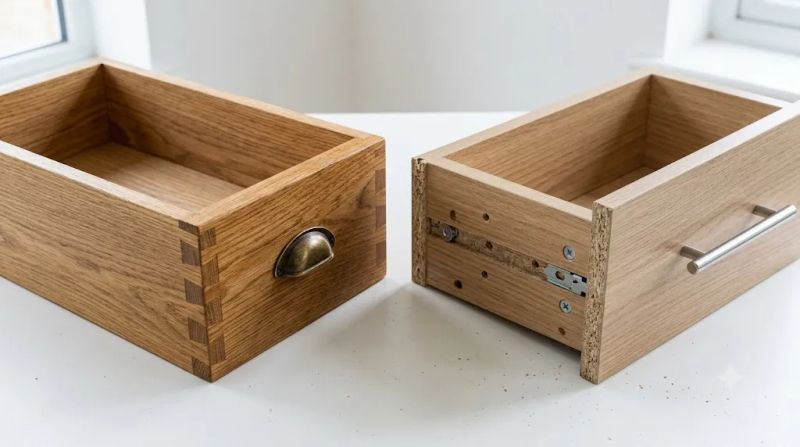
- Dovetail-jointed drawer construction — commonly found in older solid timber pieces, and rare in new furniture under $500.
- Mortise-and-tenon chair frames — a traditional joinery method associated with long-lasting furniture. More commonly found in older quality pieces than in mass-market furniture today.
Well-built solid timber furniture can last for decades when properly maintained, which is why many older pieces remain functional after 20, 30, or even 50 years. The secondhand market in Melbourne is full of pieces that have already demonstrated exactly this longevity — they have survived decades of use and are still structurally sound.
The $300 secondhand solid timber dining table is frequently a better piece of furniture than the $600 new MDF dining table from a discount retailer. The secondhand piece was built to last. The new piece was built to a price point. For a deeper look at what makes older furniture better built, our vintage vs secondhand furniture guide covers construction, materials, and how to identify quality.
Reason 3 — The environmental case is compelling
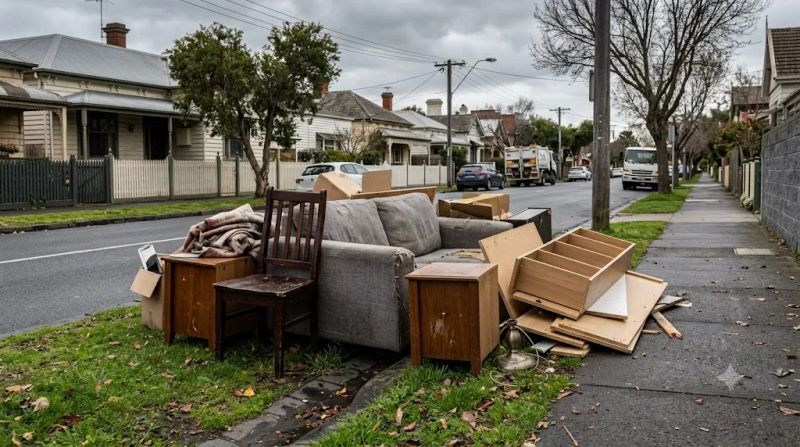
Australia has a serious furniture waste problem. According to Paul's Rubbish Removal's furniture waste statistics, millions of tonnes of furniture and household goods are discarded across Australia annually. A significant proportion of unwanted furniture still ends up in landfill because recycling and reuse pathways remain limited. According to Austate's furniture waste research, around 24kg of wooden furniture is disposed of per household annually across Australia — and the total scale is growing as fast furniture volumes increase.
Buying used furniture addresses all of these problems simultaneously:
No new manufacturing emissions. Much of the environmental footprint of manufacturing has already occurred, and extending the life of an existing piece avoids the need to produce a replacement. Every secondhand piece purchased skips new raw materials, manufacturing energy, shipping from overseas, and retail logistics.
No landfill contribution. Every Melbourne kerbside has furniture on it every week — pieces that are perfectly functional but unwanted. Buying secondhand intercepts these pieces before they reach landfill. According to Austate's research, 75% of Australians now choose to reuse furniture rather than dispose of it — a significant cultural shift toward circular consumption.
Extended product lifecycle. Pre-flat-pack solid timber furniture was almost always designed to be disassembled and repaired — which is why so much of it is still in circulation decades later. Every year of extended use is a year that a replacement piece does not need to be manufactured.
For Melbourne buyers who care about their environmental footprint, secondhand furniture is not a compromise — it is often the most sustainable choice available. A solid timber dining table bought secondhand avoids the additional environmental footprint of producing and transporting a new replacement. The same table bought new carries the full manufacturing and logistics footprint of a new production run.
Reason 4 — You get it this week, not in six weeks
Australian furniture retailers regularly deliver with 4 to 6 week wait times. Some popular pieces from premium retailers have wait times of 8 to 12 weeks. For anyone who has just moved into a Melbourne apartment and needs a sofa to sit on, a table to eat at, or a bed to sleep in, this is a serious practical problem.
Secondhand furniture in Melbourne is available today. You message the seller, agree a time, collect the piece, and it is in your home the same day or the same week. No lead times, no delivery windows, no assembling flat-pack furniture with an Allen key at 11pm. Our guide to transporting furniture in a regular car shows how straightforward pickup actually is — no ute or van required for most pieces.
For buyers in Melbourne's inner southeast — Bentleigh, Carnegie, Ormond, McKinnon — browse what local sellers are listing right now in Bentleigh East, Carnegie, or across Melbourne. Many sellers prefer their piece collected within the week. What you see today can be in your apartment by the weekend.
The speed advantage matters most when timing is tight — a new lease starting Monday, a first week in Melbourne with nowhere to sit, or a move-out deadline that leaves no room for six-week delivery windows. For anyone in that position, the secondhand market is the only practical answer.
Reason 5 — Character, history, and originality
This is the argument that does not show up in spreadsheets but matters enormously in practice.
Many mainstream furniture retailers focus on coordinated, mass-market collections at similar price points. Walk into any new Melbourne apartment building and you will see the same sofa, the same bookshelf, the same dining table in a dozen units.
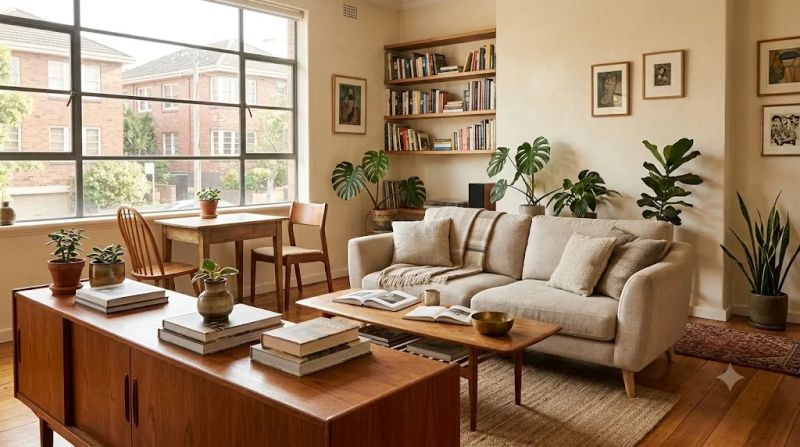
Secondhand furniture is inherently individual. A 1960s Danish teak sideboard has a character that no reproduction can replicate — because the character comes from the material, the craftsmanship, the age, and the history of the piece itself. A solid Victorian mahogany chest of drawers, a Parker dining set, a mid-century armchair with its original upholstery — these are pieces that make a room feel considered and personal, not assembled from a catalogue.
According to Bellcourt Property Group's 2026 interior design analysis, 2026 interiors increasingly prioritise personality and individuality — unique pieces that reflect the owner, not coordinated sets that reflect a retailer's floor display. The most desirable Melbourne interiors in 2026 are built from individually selected pieces with history and character — which is exactly what the secondhand market provides.
The trend of buying an entire room from a single retailer is declining. Australian homes in 2026 increasingly mix vintage, secondhand, designer, and inherited pieces. Secondhand furniture is not a budget compromise in this context — it is the design-forward choice.
Reason 6 — Secondhand furniture holds its value better
This is the least understood advantage of buying secondhand furniture — and one of the most financially significant.
New furniture depreciates immediately. A sofa that costs $1,200 new is worth $200–$400 the moment it enters a home and becomes "used." Most new flat-pack furniture loses 60 to 80% of its retail value instantly. If your circumstances change — you move, you upgrade, you need the money — new furniture is a sunk cost.
Solid timber secondhand furniture holds its value far better. A solid oak dining table bought secondhand for $200 in Melbourne can be resold for $150–$200 if it has been well maintained. You have used the piece for two years and recovered most of your purchase price. The net cost of ownership is close to zero.
Genuine vintage pieces — 1960s Danish teak, Victorian hardwood, mid-century Australian craftsman furniture — tend to hold their value far better than mass-produced furniture, and well-maintained examples often retain or even improve on their purchase price over time. This is the opposite of what happens with new flat-pack furniture, which loses most of its value the moment it leaves the store.
According to our vintage furniture guide, pieces by named Scandinavian designers routinely clear $2,000–$4,500 at Melbourne dealers — and the secondhand market regularly surfaces equivalent pieces at a fraction of that price from sellers who don't recognise what they have. Buying well in the secondhand market is not just a spending decision — it is a smarter ownership decision.
Want to know what a piece is worth before buying? Use our secondhand furniture pricing guide to compare fair market prices across Melbourne categories.
Reason 7 — What running Melbourne's furniture marketplace has taught us
After analysing furniture listings and buyer behaviour across Melbourne suburbs — from Bentleigh and Carnegie in the southeast to Brunswick and Fitzroy in the inner north — we consistently see the same patterns. Zirkly is Melbourne's dedicated secondhand furniture marketplace, focused exclusively on connecting local buyers and sellers of furniture. That focus gives us first-hand insight into what buyers search for, which pieces sell fastest, how pricing behaves across suburbs and seasons, and the real quality differences between modern flat-pack and older solid timber construction.
The categories that move fastest on the platform are solid timber dining sets, quality office chairs, genuine vintage sideboards, and well-maintained sofas in neutral colours — pieces that combine immediate utility with quality that justifies the purchase. Buyers in inner southeast suburbs like Bentleigh, Carnegie, and Ormond consistently search for solid timber and vintage pieces over flat-pack equivalents, even when the flat-pack option is cheaper. In the inner north — Brunswick, Fitzroy, Northcote — vintage and mid-century pieces move within hours of listing.
One pattern stands out above all others: buyers who switch from new to secondhand rarely go back. The combination of price, quality, and immediacy creates an experience that new retail cannot match. A buyer who discovers that the $180 solid timber dining table from a Bentleigh seller is better made than the $600 MDF table from a retailer does not forget that lesson.
The most active buyers on Zirkly are not people who cannot afford new furniture. They are people who have learned that secondhand is simply the smarter choice — better value, better quality, better for the environment, better for Melbourne's local community.
See what Melbourne locals are selling today. Browse secondhand furniture on Zirkly →
Browse what Melbourne locals are listing today at secondhand furniture Melbourne. To understand which furniture styles are driving demand in 2026, read our Australian Furniture Trends 2026 report.
Who should buy secondhand furniture in Melbourne?
Secondhand furniture is ideal for almost every buyer — but these groups benefit most:
Renters — Melbourne's rental market moves fast. Secondhand furniture is available this week, not in six weeks, and it can be resold when you move on.
First home buyers — Setting up a home from scratch is expensive. Our secondhand furniture pricing guide shows what fair market value looks like — buying used saves $2,500–$6,000 on a typical one-bedroom setup.
International students — Arriving in February or September with an empty room to furnish and a budget to manage. Affordable furniture through Melbourne's local furniture marketplace is the fastest and most affordable solution.
Young families — Furniture takes a beating with children. Solid secondhand timber pieces handle it better than flat-pack MDF, and you won't feel bad about the inevitable scratches.
People relocating to Melbourne — No furniture, no time to wait for retail delivery, no interest in flat-pack assembly. Secondhand is the practical answer. See our guide to furnishing a Melbourne apartment on a budget for a room-by-room breakdown.
Landlords and Airbnb owners — Quality pre-loved furniture at 30–80% below retail lets you furnish investment properties well without overcapitalising.
Anyone who cares about sustainability — Buying secondhand is one of the most impactful furniture choices you can make for reducing furniture waste.
The honest limitations — when new furniture makes sense
The case for secondhand furniture is strong but not absolute. There are specific situations where buying new makes practical sense.
Mattresses. The one consistent exception across every guide Zirkly has published. There is no reliable way to assess a used mattress for hygiene. Buy new.
Pieces with complex mechanical components. Electric recliner sofas, motorised beds, and similar pieces with electronics that can fail are higher-risk secondhand purchases. New furniture warranties matter here.
When you need a specific size, colour, or configuration. The secondhand market is what it is — you find what's available, not what you specified. If you need an exact configuration for a custom space, new furniture gives you that control.
Very short-term needs. If you need furniture for three months and then you're moving again, the secondhand market's resale value advantage still applies — but the effort of finding, collecting, and then reselling may not be worth it for a very short stay.
Outside these scenarios, secondhand furniture in Melbourne will almost always deliver better value than new.
What Melbourne buyers should know about the local secondhand market
Melbourne is one of the best cities in Australia for secondhand furniture — and the data supports this. The combination of a high rental turnover rate, a large population of design-literate residents, and a strong culture of sustainability makes Melbourne's secondhand furniture market exceptionally active.
PropTrack's Listings Report confirmed Melbourne recorded the busiest January for new rental listings since 2008, with listings up 27.8% year-on-year. Every household move generates furniture that needs a new home. The supply in Melbourne's used furniture market is consistently high — which is good for buyers.
Where to find secondhand furniture in Melbourne
Zirkly is Melbourne's dedicated peer-to-peer furniture marketplace — every listing is furniture, every seller is a local resident, and you can search by suburb to find what is available near you today. Our full guide to where to buy secondhand furniture in Melbourne covers every channel — Sunday markets, op shops, vintage dealers, and online platforms.
Before you buy
Read our inspection guide before collecting any upholstered piece — it covers what to check for bed bugs, condition issues, and what to walk away from. Our pricing guide tells you what fair market value looks like for every furniture category. And our negotiation guide gives you the exact scripts to use when making an offer.
Browse secondhand furniture near you in Melbourne
Ready to see what's available today? Browse thousands of secondhand sofas, dining tables, beds, office furniture, and more from local Melbourne sellers. Most listings are available for pickup this week.
Browse secondhand sofas, dining tables, beds, office furniture and more from Melbourne sellers on Zirkly at www.zirkly.com.au →
Frequently Asked Questions
Is secondhand furniture worth buying?
Yes — for most buyers in most situations, secondhand furniture delivers better value than new across every dimension that matters: price (30–80% less than retail), quality (pre-2000 solid timber furniture is often better made than new equivalents), environmental impact (diverts pieces from landfill, no new manufacturing emissions), and speed (available this week, not in six weeks). The main exception is mattresses — always buy new.
Is used furniture better quality than new furniture?
Often yes. Pre-2000 furniture — particularly solid timber pieces — was built to higher material and construction standards than most new furniture at comparable price points. Solid oak, hardwood, and dovetail-jointed construction are common in secondhand Melbourne pieces and rare in new furniture under $500–$600. A solid timber dining table bought secondhand for $200 is frequently better made than a new MDF table at $600.
What are the benefits of buying secondhand furniture in Melbourne?
Six clear benefits: price savings of 30–80% versus new retail; access to better-quality solid timber construction; environmental benefits (no new manufacturing emissions, diverts pieces from landfill); same-week availability versus 4–6 week retail lead times; character and originality versus mass-market sameness; and better resale value retention — particularly for solid timber and genuine vintage pieces.
Is buying secondhand furniture sustainable?
Yes — it is often the most sustainable furniture choice available. Buying secondhand extends the lifecycle of existing pieces, eliminates new manufacturing emissions, and diverts furniture from Australia's landfills. According to Austate's furniture waste research, a significant amount of cheap, mass-produced furniture ends up in landfill because recycling and reuse pathways remain limited. Keeping a piece in use is always better than sending it there.
Does secondhand furniture have good resale value?
Solid timber secondhand furniture holds its value significantly better than new flat-pack furniture. A solid oak table bought secondhand for $200 can typically be resold for $150–$200 after two years of use — near-zero net cost of ownership. Well-maintained vintage pieces — 1960s Danish teak, Victorian hardwood, mid-century Australian craftsman furniture — tend to hold their value far better than mass-produced furniture. New flat-pack furniture loses 60–80% of its retail value the moment it is assembled.
Where is the best place to buy secondhand furniture in Melbourne?
Zirkly is Melbourne's dedicated secondhand furniture marketplace — furniture only, every seller local, searchable by suburb. Camberwell Sunday Market (every Sunday, 7:00 am–12:30 pm) and Bentleigh Sunday Market (every Sunday, 7:00 am–12:00 pm) are Melbourne's best markets for secondhand furniture discovery. Our full guide: Where to Buy Secondhand Furniture in Melbourne.
How much can you save buying secondhand furniture in Melbourne?
Furnishing a one-bedroom Melbourne apartment from scratch costs $3,500–$8,000 new. The same apartment furnished with equivalent secondhand pieces from Zirkly costs $800–$2,000 — a saving of $2,500 to $6,000. Individual pieces typically cost 30–80% less than their new retail equivalent, with the biggest savings on sofas, dining sets, and solid timber storage furniture.
What furniture should you never buy secondhand?
A few categories are worth buying new. Mattresses — there is no reliable way to assess hygiene, and sleep quality matters too much to compromise. Heavily damaged upholstered furniture — if the frame is cracked or the springs are collapsed, no amount of cleaning helps. Furniture with missing structural parts — drawers, hardware, or supports that cannot be sourced will leave you with a piece that can't be properly used. Outside these cases, almost everything else is fair game — and our inspection guide tells you exactly what to check before you commit.
Sujith
Zirkly Team
Sujith is the Founder of Zirkly — Melbourne's dedicated secondhand furniture marketplace. With over 20 years of experience building digital products and leading product strategy, he writes about the secondhand furniture market, consumer behaviour, and the circular economy. His perspective combines technology, market research, and the experience of building a peer-to-peer furniture platform.