Secondhand Furniture and Bed Bugs — What to Check Before You Buy in Melbourne
Bed bug infestations in Australia have surged 4,500% since the late 1990s — and secondhand furniture is one of the most common entry points. Here's exactly what to check before you buy any used furniture in Melbourne.
The risk is real — and rising in Melbourne
Bed bug infestations in Australia have surged by 4,500% since the late 1990s, according to Ecosa's 2026 bed bug research. The causes are well documented: reduced use of harsh pesticides, the rise of international travel, and — critically — the growth of the secondhand goods market.
According to SA Health, bed bug populations have grown worldwide partly due to the secondhand furniture trade. Health Victoria identifies Melbourne CBD and high-density suburbs as active hotspots. The same government guidance notes that bed bugs can be transported long distances in the seams of furniture — and that early infestations are often impossible to detect without a thorough, targeted inspection.
The good news: bed bugs do not transmit disease. The bad news: a professional bed bug treatment in Melbourne costs $300–$1,500 or more, requires multiple visits, and can take weeks to fully resolve. Prevention — a thorough inspection before you buy — is infinitely cheaper and easier than treatment after the fact.
This guide tells you exactly what to look for, how to inspect any secondhand furniture before it enters your home, and what to do if you find a problem.
What bed bugs look like and where they hide in furniture
What bed bugs look like:
Adult bed bugs are small — approximately 5–7mm, roughly the size of an apple seed — flat, oval, and reddish-brown in colour. After feeding on blood they become rounder and darker. Nymphs (young bed bugs) are smaller and translucent, making them very difficult to see on light-coloured surfaces. Eggs are white, approximately 1mm, and are typically laid in clusters in crevices and seams.
According to Health Victoria's official bed bug guidance, adult bed bugs can be spotted with the naked eye on white surfaces, but are very difficult to see on brown wood and dark surfaces. The young nymphal stage is difficult to observe on any surface.
The signs you are looking for — in order of reliability:
- Black or dark brown spots — dried blood excrement, the most reliable indicator of active or recent infestation. Look like small ink spots on fabric seams, timber joints, and crevices.
- Live or dead adult bugs — reddish-brown, flat, oval, approximately the size of an apple seed.
- White eggs or shed skins — found in clusters near hiding spots. Shed skins look like translucent hollow versions of the bug itself.
- Blood staining — small rust-coloured smears on fabric, particularly on mattress seams, sofa cushion backs, and upholstery fold lines.
- Sweet, musty odour — according to Health Victoria, a heavy infestation produces a distinctive offensive sweet sticky odour sometimes described as "buggy." If a piece of upholstered furniture has an unusual sweet smell that isn't fabric freshener or cleaning product, investigate further before proceeding.
Where bed bugs hide in furniture:
Bed bugs prefer dark, narrow spaces close to where humans rest. In furniture specifically:
- Sofas and armchairs: seams, piping, under cushion covers, the fabric fold where the back meets the seat base, underside of the frame, staple lines where fabric is attached to timber
- Bed frames and headboards: all joints, screw holes, hollow sections of the frame, the underside of slats, corners where the headboard meets the frame
- Drawers and cabinets: corners of drawers, drawer slides, the back panel of cabinets, any cracks or joints
- Timber furniture generally: screw holes, joints, the underside of surfaces, decorative trim and moulding crevices
High risk vs low risk furniture — what to know before you inspect
Not all secondhand furniture carries the same bed bug risk. Understanding which categories require the most rigorous inspection saves time and helps you make an informed decision at the point of purchase.
Highest risk:
Upholstered sofas and armchairs. The highest-risk category for bed bugs in secondhand furniture. Fabric folds, seams, and the deep interior of cushions provide perfect hiding conditions. According to Reperch's used furniture bed bug guide, if you are buying upholstered furniture secondhand, inspection must be thorough — and even then, risk remains higher than with hard-surface pieces.
Bed frames and headboards. Bed bugs are most commonly found in sleeping areas. A secondhand bed frame — particularly a hollow or slatted timber frame — is a high-risk item. Headboards attached to walls are common hiding spots. Many pest experts recommend avoiding secondhand mattresses altogether, and this advice should be taken seriously.
Furniture from storage units. Any piece that has been stored in a facility shared with other people's belongings carries elevated risk. Storage units provide ideal dark, undisturbed conditions for bed bug survival and population growth.
Moderate risk:
Timber furniture with many joints and crevices — dining chairs, bookshelves with adjustable fittings, ornate vintage pieces with carved details. Harder to infest than upholstered pieces but still require checking joints, screw holes, and crevices.
Lower risk:
Solid hard-surface furniture — glass-top tables, metal-frame furniture, smooth solid timber with minimal joints. According to Reperch's inspection guide, hard surfaces are easier to clean and inspect, making them a safer secondhand choice. Still inspect — but the probability of harbouring a hidden infestation is significantly lower.
How to inspect secondhand furniture for bed bugs — step by step
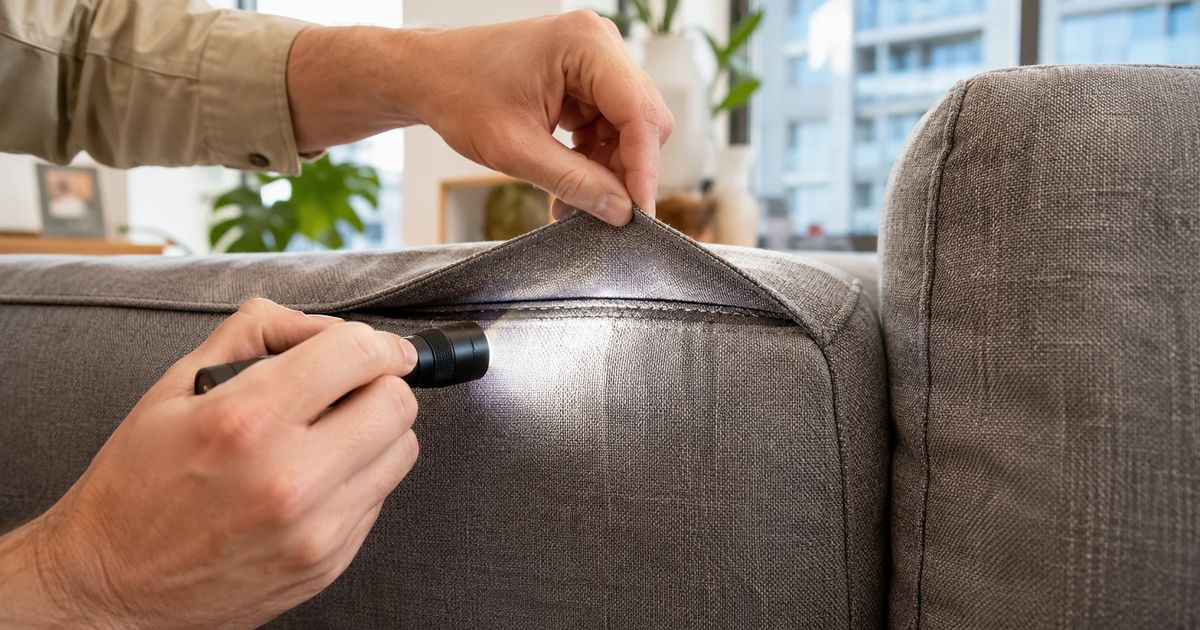
Do this inspection at the seller's location, in good light, before any money changes hands. Bring a torch — a phone torch works — and ideally a credit card or thin flat tool to run along seams and into crevices.
Step 1 — Start with the obvious surfaces in good light
Look at all visible fabric surfaces in natural or bright artificial light. You are looking for the black spots, rust stains, and shed skins described above. Check the top of cushions, the back of the sofa, the underside of armrests, and the fabric along the base.
Step 2 — Remove and inspect cushions
Remove all loose cushions. Inspect the fabric cover on each cushion — particularly the seams, piping, and zipper line. Turn each cushion over and look at the underside. Check the surface the cushions were resting on — this area is often where early evidence of an infestation first appears.
Step 3 — Inspect seams and piping with a torch
Run a torch along every seam and piping line on upholstered pieces. Bed bugs prefer these narrow spaces. Look for the black spotting and shed skins at every seam junction. Pay particular attention to where fabric meets timber framing.
Step 4 — Check the underside of the piece
Turn chairs upside down if possible. For sofas, lift the front and look at the underside of the frame. According to Newentor's 2025 bed bug guide for Australia, a flashlight is essential when inspecting furniture in dark areas — bed bugs hide in the darkest places available.
Step 5 — Inspect all joints, screw holes, and crevices
On timber components — legs, frames, drawer edges — run your torch along all joints and push your flat tool gently into any gaps. Bed bugs have been found hiding inside screw holes according to Anderson Pest Solutions' prevention guide. No space is too small to check.
Step 6 — For drawers and cabinetry
Remove every drawer completely. Inspect the inside corners, the drawer slide, and the back panel of the cabinet. Slide a card along the junction between the drawer and the cabinet frame. Check the back panel of the cabinet — particularly if the back is made of thin board.
Step 7 — The smell test
Before you leave, smell the piece closely. A heavy infestation produces a distinctive sweet, musty odour. If the piece has an unusual sweet smell that isn't cleaning product or fabric freshener, treat this as a warning sign and do not proceed.
If you find anything suspicious: do not buy the piece. Politely decline and, if the seller is a private individual who may be unaware, let them know what you found so they can address the problem.
Other pests to check for — dust mites, termites, and fleas
Bed bugs get most of the attention, but they are not the only pest risk in secondhand furniture.
Dust mites
Dust mites are microscopic and invisible to the naked eye — you cannot inspect for them visually. They are present in virtually all soft furnishings to some degree and are a leading cause of indoor allergen reactions including asthma, rhinitis, and eczema. Furniture that has been stored in damp conditions, basements, or storage units is at higher risk of elevated dust mite populations.
What to do: for any upholstered secondhand piece, a thorough vacuum on arrival followed by steam cleaning the fabric significantly reduces dust mite populations. A high-temperature steam cleaner (available for hire in Melbourne from equipment hire centres) kills dust mites on contact at temperatures above 55°C.
Termites
Termites are a serious concern for solid timber furniture in Australia, particularly pieces that have been stored outdoors, in garages, or in damp conditions. According to SA Health, timber furniture transported from interstate can carry pests including termites into new environments.
What to look for: hollow-sounding areas when you tap the timber, fine powdery dust (frass) around joints and beneath the piece, tiny holes in the timber surface, and visible mud tunnels on the underside of the piece. If you find any of these signs on a solid timber piece, do not bring it into your home.
Fleas
Furniture from homes with pets can carry fleas — particularly in fabric and carpet-covered pieces. Fleas are visible (they jump) but eggs and larvae are not. A piece that smells strongly of pets and has fine dark specks in the fabric may have flea eggs or flea dirt (dried blood) present.
What to do: for any upholstered piece from a pet household, steam clean immediately on arrival before placing it in a room where you live.
What to do after you bring secondhand furniture home
Even after a thorough inspection, taking a few precautionary steps when a secondhand piece arrives home adds an extra layer of protection.
For upholstered pieces (sofas, armchairs, bed bases):
- Before bringing the piece inside, do a final inspection in daylight outside the home
- Vacuum thoroughly with a crevice tool on all seams, joints, and undersides before placing it in your living space
- Consider a steam clean — high-temperature steam kills bed bugs at all life stages including eggs. According to Health Victoria, bed bugs die within one hour at temperatures over 45°C and immediately at 60°C
- Dispose of the vacuum bag immediately in a sealed bag in an outdoor bin
For timber furniture with joints and crevices:
- Wipe down all surfaces with a damp cloth
- Run a torch along all joints and screw holes one final time in good light before placing the piece in your home
- If you have any concerns, a licensed pest inspector can assess a single piece for a relatively low call-out fee
For pieces from storage:
Apply the highest level of precaution — full inspection, vacuum, and steam before the piece enters your home.
What to do if you find bed bugs in furniture you already bought
Act immediately. The longer you wait, the more the infestation spreads.
Step 1 — Isolate the piece. Move it away from walls and other furniture. Place the legs in smooth bowls of water or apply bed bug interceptor traps under each leg to prevent spread across your floor.
Step 2 — Do not move it through the house. Moving infested furniture through rooms spreads bed bugs to new areas. Keep it in one location until treated.
Step 3 — Contact a licensed pest control operator in Melbourne. According to Health Victoria, DIY methods are often insufficient for established infestations. A licensed pest control operator will use targeted insecticides, heat treatment, or a combination. Multiple visits are typically required. In Melbourne, bed bug treatment from a licensed operator starts from approximately $300–$600 for a single room and can run to $1,500 or more for a whole-home treatment.
Step 4 — Contact the seller. If you purchased the piece from a private seller through a marketplace and can demonstrate the infestation was present at the time of purchase, contact them immediately. Resolution will depend on the seller's good faith — there is no automatic right of return for private secondhand sales in Victoria in cases of undisclosed pest infestation, but many sellers will cooperate when approached promptly.
Step 5 — Report to Consumer Affairs Victoria if the seller was a commercial retailer (a shop or professional reseller) and refuses to engage. Commercial sellers have obligations under Australian Consumer Law. Contact Consumer Affairs Victoria for guidance.
How to buy secondhand furniture safely in Melbourne
The risk of buying bed bug-infested furniture in Melbourne is real but entirely manageable with a disciplined approach.
Always inspect in person before buying. No photo tells you whether a piece is infested. Every secondhand upholstered piece and every bed frame should be inspected physically at the seller's location before any money changes hands.
Bring a torch. A phone torch is sufficient. You cannot inspect properly in dim indoor lighting.
Ask the seller directly. "Have you had any pest issues in the home recently?" is a reasonable question. A genuine seller will answer honestly. A seller who becomes defensive or evasive at a straightforward question is a warning sign.
Buy locally. Buying furniture from a local Melbourne seller whose suburb and home you can visit in person is significantly safer than buying from an interstate seller or arranging a pickup from a storage facility. Local transactions allow proper inspection in context.
Zirkly is Melbourne's dedicated secondhand furniture marketplace — every listing shows the seller's suburb, every transaction is local, and buyers visit the seller's home to inspect in person before purchasing. This is exactly the right approach for safe secondhand furniture buying in Melbourne.
Browse local listings at www.zirkly.com.au →
Frequently Asked Questions
Can you get bed bugs from secondhand furniture in Australia?
Yes. Secondhand furniture — particularly upholstered sofas, armchairs, and bed frames — is one of the most common ways bed bugs enter Australian homes. According to SA Health, the secondhand furniture trade is explicitly identified as a contributing factor to bed bug population growth in Australia. Bed bug infestations have surged 4,500% since the late 1990s according to Ecosa's 2026 research.
How do I check secondhand furniture for bed bugs?
Inspect in good light with a torch. Look for black or dark brown spots (dried excrement), shed skins, white eggs, and live or dead bugs in seams, piping, joints, screw holes, and crevices. Remove all cushions and inspect the fabric covers, seams, and the surfaces beneath. Check the underside of the piece and all timber joints. Smell the piece — a heavy infestation produces a distinctive sweet, musty odour. Do this inspection at the seller's location before any money changes hands.
What secondhand furniture has the highest risk of bed bugs?
Upholstered sofas and armchairs carry the highest risk — fabric seams, piping, and deep cushion interiors provide ideal hiding conditions. Bed frames and headboards are also high risk as bed bugs prefer sleeping areas. Furniture from storage units is elevated risk due to dark, undisturbed conditions. Solid hard-surface furniture with minimal joints is the lowest risk category.
Are bed bugs common in Melbourne?
Yes. According to Ecosa, Melbourne CBD is specifically identified as a hotspot for bed bug infestations alongside Sydney's Inner West and other high-density suburbs. The 4,500% surge in infestations since the late 1990s reflects a nationwide trend that is pronounced in high-density urban areas.
How much does bed bug treatment cost in Melbourne?
Professional bed bug treatment in Melbourne starts from approximately $300–$600 for a single room and can reach $1,500 or more for a whole-home treatment. Multiple visits are typically required. This cost significantly exceeds the price of most secondhand furniture purchases — making prevention through inspection the clearly better approach.
Should I buy a secondhand sofa if I'm worried about bed bugs?
Yes — with a thorough inspection. Most secondhand sofas in Melbourne are completely free of bed bugs. The risk is real but manageable. Inspect thoroughly at the seller's home using the step-by-step method in this guide. Buy from local Melbourne sellers you can visit in person rather than from storage facilities or interstate. If any inspection step reveals suspicious signs, walk away.
Can I get rid of bed bugs in furniture I've already bought?
For a minor infestation on a solid timber piece, steam cleaning at temperatures above 60°C is effective. For upholstered pieces with an established infestation, professional treatment is required — DIY methods are rarely sufficient according to Health Victoria. In severe cases, disposal may be the only practical option. Prevention through inspection before purchase is far cheaper and simpler.
What other pests should I check for in secondhand furniture?
Beyond bed bugs, check for termites (hollow-sounding timber, fine powdery dust, tiny holes in the surface), fleas (visible jumping insects, fine dark specks in fabric from pet homes), and consider dust mites in any fabric piece stored in damp conditions. Steam cleaning any secondhand upholstered piece on arrival addresses all three at once.
Erica
Zirkly Team
Erica explores the relationship between furniture, interiors, and everyday living in Melbourne and beyond. She writes about sustainable interiors, secondhand furniture, vintage design, and interior trends, with a focus on making thoughtful design choices more approachable. Her perspective combines an appreciation for timeless pieces with a belief that the most meaningful spaces are built around furniture with history and character.