Garage Sale vs Selling Furniture Online: Which Is Better in Melbourne?
Garage Sale or Sell Online? What Actually Moves Furniture? One is a single Saturday and a weather gamble. The other runs until the right buyer finds it. A founder's honest comparison for Melbourne sellers.
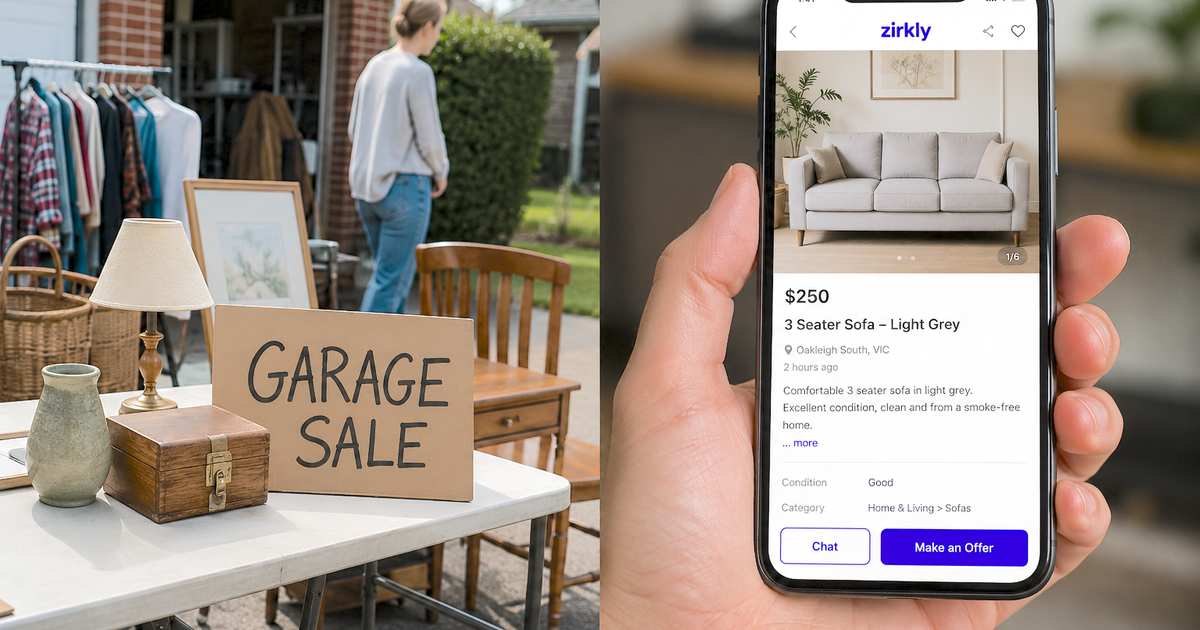
A garage sale and an online listing solve the same problem in completely different ways. One is a single Saturday where you hope the right people walk past. The other runs quietly in the background until the right person finds it — whenever that happens to be.
Neither is wrong. But for furniture specifically, the two methods perform very differently, and knowing why helps you pick the right one for what you're actually trying to clear. If you're deciding whether to hold a garage sale or sell furniture online in Melbourne, here's how the two compare on price, speed, effort and likelihood of selling.
The traditional garage sale: what it actually costs you
A garage sale isn't free, even though no money changes hands to run one. It costs a full day — set-up from early morning, sitting outside for hours, pack-down in the afternoon — and it only works if the weather cooperates, since Melbourne's forecast rarely gives you much notice either way.
It also costs preparation: pricing everything the night before, finding change for a cash box, making signs, and getting the word out at all — a garage sale nobody hears about is a garage sale nobody comes to, so signs, local noticeboards and posts in community groups are all part of the real setup, not just a courtesy. For furniture specifically, there's an extra cost most people don't think about until the day: moving heavy pieces outside and back in again if they don't sell.
Selling online: what changes
An online listing removes the single-day pressure entirely. Once it's up, it's visible every hour of every day until it sells — no early alarm, no weather gamble, no packing the good armchair back inside at 4pm because nobody wanted it.
The furniture doesn't move until someone commits to buying it, which means no wasted lifting for pieces that don't sell on the day. And because the listing includes photos and a description, buyers already know what they're getting before they show up — which cuts down on time-wasting "just looking" visits that fill a garage sale morning.
Reach: passersby vs the whole neighbourhood
This is the biggest structural difference between the two. A garage sale's audience is whoever happens to walk or drive past your specific street that morning — a small, random, entirely local pool, and mostly people who weren't necessarily looking to buy furniture that day.
An online listing's audience is everyone nearby who's actively searching for exactly that kind of piece. On Zirkly, listings are actively matched to buyers in the surrounding suburbs — so instead of hoping the right passerby exists, the furniture gets shown to people who've already indicated they want a dining table, a sofa, or whatever you're selling. That's a fundamentally larger and more relevant pool than anyone walking past a single driveway.
Think about it from the buyer's side too. Someone specifically looking for a dining table isn't going to spend their Saturday driving street to street hoping to spot one in a driveway — but they will search for exactly that online, on their own schedule. A garage sale relies on a buyer stumbling across the right item by chance; a listing relies on a buyer searching for the right item on purpose. The second version has a much higher success rate for anything specific, and furniture is almost always something specific.
At a glance:
| Factor | Garage sale | Online listing |
|---|---|---|
| Buyers | Passersby | Actively searching |
| Time | One morning | Available 24x7 |
| Weather | A real risk | Irrelevant |
| Heavy lifting | Twice, if it doesn't sell | Once maybe, at handover |
| Best for | Cheap household items | Furniture |
| Price | Often negotiated down on the day | Easier to hold firm |
| Reach | One street | Multiple suburbs |
| Preparation | High — signs, change, set-up | Moderate — photos and a listing |
Weather, timing and the one-shot problem
A garage sale has exactly one chance to work. Rain moves it, a cold snap keeps people home, and a clashing local event can empty the street of foot traffic entirely. Melbourne weather can turn four seasons into one afternoon, which makes garage sales especially unpredictable — if the day doesn't work, you're rescheduling everything: the signs, the morning, the whole plan, for another weekend.
An online listing has no weather. It sits there through a rained-out Saturday just as well as a sunny one, and a slow first few days doesn't mean starting over — a price tweak or a better photo can revive it without any of the setup cost repeating.
Payment and safety
Garage sales run on cash, which means a cash box sitting on a table in your driveway, and strangers walking up your front path all day to look at what's for sale in and around your home. Most days that's completely fine — but it is a different risk profile to arranging one buyer, at one agreed time, for one item.
Online selling flips that: you agree a time with one buyer, meet at the handover, and — if you take payment by PayID rather than cash — the transaction leaves a record on both sides. Our guide on spotting a secondhand furniture scam covers the handful of warning signs worth knowing either way.
Pricing power: the haggling crowd vs one buyer at a time
Garage sale pricing tends to collapse as the day goes on. Early browsers negotiate hard because they know more stock is coming out all morning, and by early afternoon most sellers are dropping prices just to avoid carrying everything back inside — furniture included, and furniture is exactly the stuff nobody wants to carry back in.
Selling online, you set one price for one buyer with no crowd pushing it down in real time, and our guide on negotiating secondhand furniture in Melbourne covers how to handle offers without giving away more than you meant to. Our guide to pricing secondhand furniture is worth a look either way — the same pricing logic applies whichever method you choose, it's just easier to hold a fair price online than in front of a haggling queue.
What garage sales still do well
None of this means garage sales are pointless — they're genuinely good at a few things online selling isn't.
A garage sale clears a huge volume of low-value odds and ends in one hit — the box of cables, the chipped mugs, the paperbacks nobody's going to photograph and list individually. It needs zero listing effort per item, which matters when you're decluttering a whole house at once. And there's a genuine neighbourly angle: some people simply enjoy the Saturday-morning version of it, chatting with whoever stops by.
What it isn't well suited to is furniture specifically — the pieces worth real money (our guide to what secondhand furniture actually sells covers which pieces those tend to be), that are heavy to move twice, and that deserve a buyer who actually wants that exact piece rather than whoever happens to be walking past.
One practical note if you're planning a sale: some Melbourne councils have rules about what can go on the nature strip or footpath, including signage — worth a quick check with your council before the morning of the sale, rather than finding out from a passing ranger. And for whatever's left over at the end of the day, our decision guide on what to do with old furniture in Melbourne covers selling, donating and disposing of it properly rather than it sitting in the garage until the next one.
The hybrid approach
The two methods aren't mutually exclusive, and combining them is often the smartest move. List your good furniture online in the week before a planned garage sale — the pieces worth real money get proper photos, a fair price and the right buyer, without the risk of them sitting unsold in the driveway. Then run the garage sale for genuinely low-value items where a listing wouldn't be worth the ten minutes it takes to create.
If the whole house is being cleared rather than just a Saturday's worth of clutter — a move, a downsize, an estate — the logic scales up too. Our week-by-week guide to selling furniture before moving house and our founder's playbook on selling secondhand furniture faster both cover listing a whole household's worth of furniture properly, which a single garage sale morning was never really built to do.
Skip the driveway. List your furniture free on Zirkly — AI helps write the listing in seconds, and it stays online until the right buyer finds it, rain or shine. Browse second hand furniture in Melbourne or create your first listing today.
Frequently Asked Questions
Is it better to have a garage sale or sell furniture online in Melbourne?
For furniture specifically, online usually wins — a wider, more relevant pool of buyers, no weather risk, and no pressure to drop the price as the day runs out. Garage sales still do well for large volumes of low-value items that aren't worth listing individually.
Do I need a permit for a garage sale in Melbourne?
Rules vary by council, and some do regulate signage on nature strips and footpaths, so it's worth a quick check with your local council before the day rather than assuming anything goes. The sale itself in your own driveway or yard is generally not an issue; it's signage and public space use that differs most between councils.
How much more can I make selling furniture online instead of at a garage sale?
It depends on the piece, but online selling generally holds price better because there's no crowd pushing it down and no deadline forcing a discount. A garage sale's real strength is speed and volume for cheap items, not maximising the price of individual furniture.
Is selling furniture online safe?
Yes, with the same basic precautions as any in-person transaction — meet in daylight, trust your instincts, and take payment by PayID rather than cash where you can, since it leaves a record for both sides. Our guide on spotting a secondhand furniture scam covers the specific warning signs to watch for.
Can I do a garage sale and sell furniture online at the same time?
Yes, and it's often the best of both — list the furniture worth real money online in the days before, where it gets proper photos and a fair price, and use the garage sale itself for the smaller, lower-value items that aren't worth listing individually.
What sells better at a garage sale versus online?
Garage sales suit small, cheap, high-volume items — books, kitchenware, odds and ends. Furniture generally sells better online, since it's worth more, harder to move twice, and benefits from being matched to a buyer who specifically wants that piece rather than whoever happens to walk past.
Are garage sales still popular in Melbourne?
Yes — they're still a common way to clear a house during a move, a downsize or a general clean-up, particularly once the weather turns milder in spring and autumn. Furniture specifically tends to do better listed online, though, since buyers can search for the exact piece they want rather than stumbling across it.
How long does furniture usually take to sell online?
It depends on price, condition and demand. Furniture in good condition that's priced fairly and photographed well tends to sell within days to a couple of weeks; more specialised or bulky pieces can take longer. Good photos and an honest description usually make the biggest difference either way.
Sujith
Zirkly Team
Sujith is the Founder of Zirkly, Melbourne's dedicated secondhand furniture marketplace. He writes about Melbourne's secondhand furniture market, consumer behaviour, and the circular economy, drawing on his experience building Zirkly and what helps furniture listings sell across Melbourne.
More from Insights

Secondhand Bedroom Furniture in Melbourne: What to Do With It After a Wardrobe Clean-Out
22 Aug 2026
Furniture Waste in Australia: The Real Numbers Behind Landfill (and How Zirkly Fits In)
5 Aug 2026
Granny Flat Furniture Melbourne: A Secondhand Guide to Furnishing a Secondary Dwelling
31 July 2026