How to Spot a Secondhand Furniture Scam in Australia — and What to Do If It Happens to You
Secondhand furniture scams are rising across Australian online marketplaces. Here's how to spot them, avoid them, and what to do if you've been targeted — with real red flags from Scamwatch.
Furniture scams are more common than most Australians realise
Australians made 481,523 scam reports in 2025, with total reported losses of $2.18 billion — a 7.8 per cent increase from 2024, according to the National Anti-Scam Centre's Targeting Scams Report. Shopping scams — the category that includes fake listings for secondhand goods including furniture — were the most reported scam type involving financial loss in 2025, with more than 9,600 reports in the first nine months of the year alone.
Online contact methods including fake websites, social media advertisements, and marketplace listings accounted for around half of all reported Scamwatch losses in the first quarter of 2026. Scammers are not just targeting luxury items or electronics. Everyday secondhand goods — sofas, dining tables, bed frames, bookshelves — are routinely used as bait, particularly on platforms like Facebook Marketplace and Gumtree where buyers are used to transacting with individuals they don't know.
The good news is that furniture scams follow predictable patterns. Once you know what to look for, they are relatively easy to spot. This guide covers every red flag, every verification step, and exactly what to do if something goes wrong.
The most common secondhand furniture scam types in Australia
Non-delivery listings
The most common furniture scam in Australia. A seller lists a piece of furniture at an attractive price, requests payment upfront or a deposit, and then disappears. The furniture never arrives and the seller cannot be contacted. This scam is especially common with larger, higher-value pieces — wardrobes, dining sets, sofas — where the promise of avoiding a retail price makes the risk feel worth taking.
How it works: The seller may have a convincing profile, good photos (often stolen from legitimate listings elsewhere), and a plausible story — relocating interstate, downsizing, clearing a storage unit. They create urgency ("I have three other people interested") and then request bank transfer, PayID, or payment before you can inspect.
The buyer overpayment trap
This one targets sellers, not buyers. A fake "buyer" contacts you about your listing, claims to be interstate, and offers to pay by bank transfer for more than the asking price — often with a story about "accidentally" sending too much. They then ask you to refund the difference. The original payment is fraudulent and is reversed, leaving you out of pocket for whatever you refunded.
Hijacked & replicated ads
Scammers lift photos and descriptions from legitimate furniture listings on one platform and repost them on another at a lower price. The furniture exists — just not for sale by the person claiming to sell it. Buyers pay for a piece they saw on a trusted platform but are actually paying a scammer who has replicated the listing.
Misrepresented condition & hidden damage
Not always criminal, but increasingly common: sellers misrepresent the condition of furniture, often using old or digitally altered photos that hide significant damage, staining, smoke odour, or structural problems. By the time you discover the issue, the seller has your money and is unresponsive.
Red flags — how to spot a furniture scam before you lose money
The price is significantly below market value
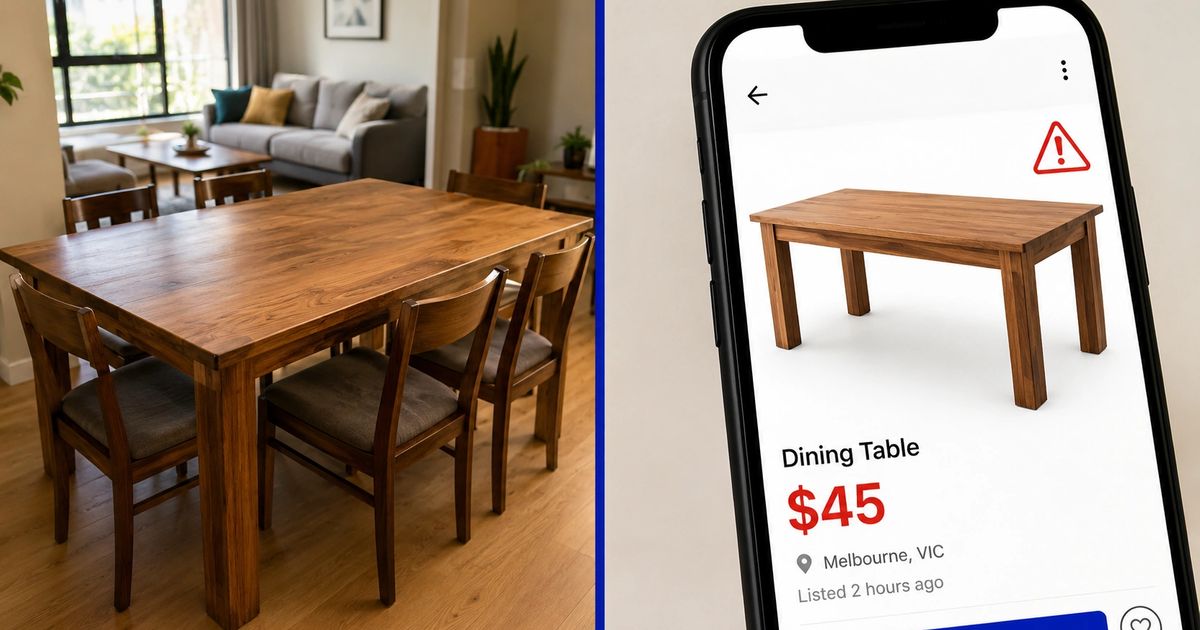
If a three-seater sofa is listed for $50 when comparable pieces are selling for $200–$400, ask why. Genuine sellers occasionally price low to move quickly, but dramatically below-market prices on desirable pieces are the most reliable signal that something is wrong. Cross-check similar listings on a local second hand furniture marketplace before proceeding.
The seller won't let you inspect in person
This is the clearest single red flag for furniture specifically. Furniture is a physical, bulky item. Any genuine seller in Melbourne expects you to come and see it. A seller who insists on payment before inspection, claims to be interstate or overseas, or offers to "arrange delivery" without allowing a viewing is almost certainly running a scam.
The seller creates urgency
"I have three other people coming to look tomorrow." "I need this gone by the weekend." "First payment gets it." Urgency is a manipulation tactic. Genuine sellers want to find the right buyer — not pressure you into an irreversible decision. Take the time you need.
Payment methods that offer no protection
A seller who insists on bank transfer, Western Union, cryptocurrency, gift cards, or Venmo-style apps that don't offer buyer protection is a red flag. Legitimate private sellers in Australia accept cash on pickup, or PayID for trusted buyers. Anyone who refuses cash and insists on a specific payment method before you see the piece is a warning sign.
The photos look too professional or out of place
If the listing photos look like they're from a furniture catalogue rather than someone's actual home — no walls, no floors, no natural context — reverse image search them. On Google Images, right-click (or long-press on mobile) and select "Search image." If the same photos appear on a different seller's listing, or on a retailer's website, the listing is fraudulent.
The profile is new or sparse
Check how long the seller's account has been active and what other activity they have. A brand-new profile with a single listing and no history is a risk signal. Scammers create accounts specifically for individual fraud attempts.
Replies come at odd hours or feel scripted
Scam accounts are often operated offshore or use scripted responses. If replies arrive at 3am Melbourne time, use unusual phrasing, or avoid directly answering specific questions about the piece, be cautious.
How to verify a seller is genuine
Ask specific questions about the piece. A genuine seller will easily answer questions about the material, dimensions, age, where they bought it, and why they're selling. A scammer working from stolen photos will give vague or inconsistent answers.
Request a live photo with today's date. Ask the seller to send a photo of the piece with a handwritten note showing today's date and your name — or showing it next to a current newspaper. A genuine seller with the piece in front of them will do this. A scammer cannot.
Verify the suburb. Ask for the exact suburb and cross-reference it with their profile. If they claim to be in Bentleigh but their profile shows activity in a different state or country, something is wrong.
Reverse image search the listing photos. Free and takes 30 seconds. If the images appear elsewhere, don't proceed.
Check their other listings and reviews. Established sellers on most platforms have a history. New profiles with no reviews and a single listing are higher risk.
Search the item on other platforms. Scammers often copy listings from one platform to another. If you find the exact same listing on a different platform with a different seller, report both immediately.
Safe payment methods for buying secondhand furniture in Australia
Cash on pickup — the safest option for secondhand furniture. Pay when you physically have the piece in front of you. No payment before inspection, ever.
PayID — safe for trusted transactions. PayID links to a verified Australian bank account and processes instantly. It's appropriate once you've inspected the piece and are satisfied. It does not offer the same buyer protection as a credit card, but it is faster and safer than a standard bank transfer for private sales.
Credit card — if the platform supports it. Credit card payments offer the strongest buyer protection, including the ability to charge back a fraudulent transaction. Not all private sellers accept credit card, but some platforms do. Use it when available.
Avoid: standard bank transfer (BSBS) before inspection, cryptocurrency, gift cards, Western Union or MoneyGram, and any payment method the seller insists on that you're unfamiliar with.
According to Scamwatch, you should never transfer money or provide financial information before seeing items in person. This single rule eliminates the vast majority of secondhand furniture scams.
How to arrange a safe furniture pick-up or handover
Always inspect before you pay. No matter how trusted the seller seems, physically inspect the piece before any money changes hands. Sit on sofas. Open drawers. Check for odour. Test structural stability.
Meet at the seller's address, not a neutral location. For furniture, this is practical — the piece is at the seller's home. A seller who wants to meet at a car park or neutral location rather than their address is an immediate red flag.
Bring someone with you. For safety and as an extra pair of eyes on the piece. Two people assessing a sofa catch more than one.
Tell someone where you're going. Share the address and seller's contact details with a friend or family member before you leave.
Check the piece matches the listing before paying. If the item looks significantly different from the photos — worse condition, different colour, signs of damage — you are not obligated to complete the purchase. Walk away.
For Zirkly listings in Melbourne: every listing shows the seller's suburb. You can message through the Zirkly app, see the seller's listing history, and arrange pickup knowing exactly where you're going and what you're picking up.
What to do if you've been scammed
If you believe you've been the victim of a secondhand furniture scam in Australia, act immediately.
Step 1 — Contact your bank. If you paid by bank transfer, contact your bank immediately and request they attempt to recall the payment. The faster you act, the better the chance of recovery. If you paid by credit card, initiate a chargeback.
Step 2 — Report to Scamwatch. Visit scamwatch.gov.au and submit a report. Your report helps the National Anti-Scam Centre track and disrupt scam activity — even if you don't recover your money, your report protects others. The ACCC received 45,816 scam reports in the first three months of 2026 and took down 5,834 scam websites as a result of reports from the public.
Step 3 — Report to the platform. Report the fraudulent listing and seller account to the platform where the scam occurred. Most platforms — Facebook Marketplace, Gumtree — have reporting mechanisms. This gets the account removed quickly.
Step 4 — Report to Victoria Police. For significant financial losses, file a report with Victoria Police at police.vic.gov.au or call 131 444. You can also report online through ReportCyber for cybercrime-related fraud.
Step 5 — Contact IDCARE if your personal details were compromised. If you shared personal information — driver's licence, passport, bank details — contact IDCARE on 1800 595 160. They provide free specialist support for identity and cyber security concerns.
Step 6 — Seek emotional support if needed. Being scammed is distressing regardless of the amount lost. Beyond Blue (1300 22 4636) and Lifeline (13 11 14) provide support if you need to talk to someone.
How Zirkly protects buyers and sellers in Melbourne
Zirkly is Melbourne's dedicated secondhand furniture marketplace — and it was built specifically to address the problems that make general classifieds risky.
Every listing on Zirkly is furniture-only. Every seller is a local Melbourne resident. Every listing shows the seller's suburb, so you know exactly where you're going before you message. Because the platform is local and community-facing, anonymous or fraudulent behaviour is far more difficult to sustain than on large national classifieds platforms.
Zirkly's approach to safety:
- Listings are location-verified — you browse by suburb, not by anonymous national listings
- Sellers are real Melbourne locals — not interstate or overseas accounts
- Messaging happens in-platform before any personal contact information is shared
- Every listing is furniture-specific — no irrelevant categories or mass-listed spam accounts
The safest secondhand furniture transaction is always one where you can inspect in person, in the seller's local suburb, with a platform that shows you who you're dealing with before you make contact. That's what Zirkly is built for.
Browse local listings at zirkly.com.au — and buy with the confidence that the piece you're buying is real, local, and exactly where it says it is.
Buy furniture safely on Zirkly
Every listing on Zirkly is local to Melbourne, posted by a real seller in your suburb. Browse secondhand furniture near you — inspect in person, pay on pickup, and buy with confidence.
Frequently Asked Questions
How common are secondhand furniture scams in Australia?
Shopping scams — which include fake secondhand furniture listings — were the most reported scam type involving financial loss in Australia in 2025, with more than 9,600 reports in the first nine months of the year. Total reported scam losses across all categories reached $2.18 billion in 2025, according to the National Anti-Scam Centre's Targeting Scams Report. Online contact methods including social media and fake marketplace listings accounted for about half of all Scamwatch losses in early 2026.
What are the biggest red flags for a secondhand furniture scam?
The clearest red flags are: a seller who refuses to let you inspect the piece in person before paying; a price significantly below comparable listings; a new account with no history; stolen listing photos (check with reverse image search); and any request to pay via bank transfer, cryptocurrency, or gift cards before seeing the item. A genuine furniture seller in Melbourne will always let you come and look.
Is Facebook Marketplace safe for buying secondhand furniture in Melbourne?
Facebook Marketplace has a known scam problem — the ACCC referred more than 7,000 suspected Facebook scam URLs to Meta in 2025 for investigation. It can be used safely if you follow core rules: inspect before you pay, meet at the seller's address, pay in cash on pickup, and reverse image search the photos. Dedicated furniture platforms like Zirkly offer a safer alternative because every listing is local and furniture-specific.
What is the safest way to pay for secondhand furniture in Melbourne?
Cash on pickup, paid after you have inspected the piece and are satisfied, is the safest payment method for private secondhand furniture sales. If the seller is trusted and you've already inspected the item, PayID is a fast and safe option. Never pay before inspection, regardless of how legitimate the seller appears.
What should I do if I've been scammed buying secondhand furniture?
Act immediately: contact your bank to attempt to recall the payment, report to Scamwatch at scamwatch.gov.au, report the listing to the platform, and for significant losses, file a report with Victoria Police or through ReportCyber. If personal information was shared, contact IDCARE on 1800 595 160 for specialist identity support.
How do I check if a secondhand furniture listing is genuine?
Reverse image search the photos, ask specific questions the seller can only answer if they have the piece, request a live photo with today's date written on paper, and verify the suburb matches their profile. Inspect in person before any money changes hands. On Zirkly, every listing is local to Melbourne and shows the seller's suburb — which means verification starts before you even make contact.
Can I get my money back if I'm scammed?
Possibly — depending on how you paid and how quickly you act. Credit card chargebacks offer the best chance of recovery. Bank transfer recalls depend on how fast you contact your bank — within hours gives the best chance, as funds can be recalled before the scammer moves them. Cryptocurrency and gift card payments are almost never recoverable. Report to Scamwatch regardless of payment method — it helps disrupt the scammer for future victims even if recovery isn't possible for you.
Where do I report a secondhand furniture scam in Australia?
Report to Scamwatch (run by the ACCC), the platform where the scam occurred, and Victoria Police via police.vic.gov.au or ReportCyber for cybercrime-related fraud. Report all three — each report feeds into a different disruption system.
Sujith
Zirkly Team
Sujith is the Founder of Zirkly — Melbourne's dedicated secondhand furniture marketplace. With over 20 years of experience building digital products and leading product strategy, he writes about the secondhand furniture market, consumer behaviour, and the circular economy. His perspective combines technology, market research, and the experience of building a peer-to-peer furniture platform.