How to Restore Teak Furniture: Cleaning and Oiling Guide
Learn how to restore indoor teak furniture, identify its finish, clean it safely and choose the right treatment for bare timber or coated mid-century pieces.
Last updated: 19 October 2026
Quick summary
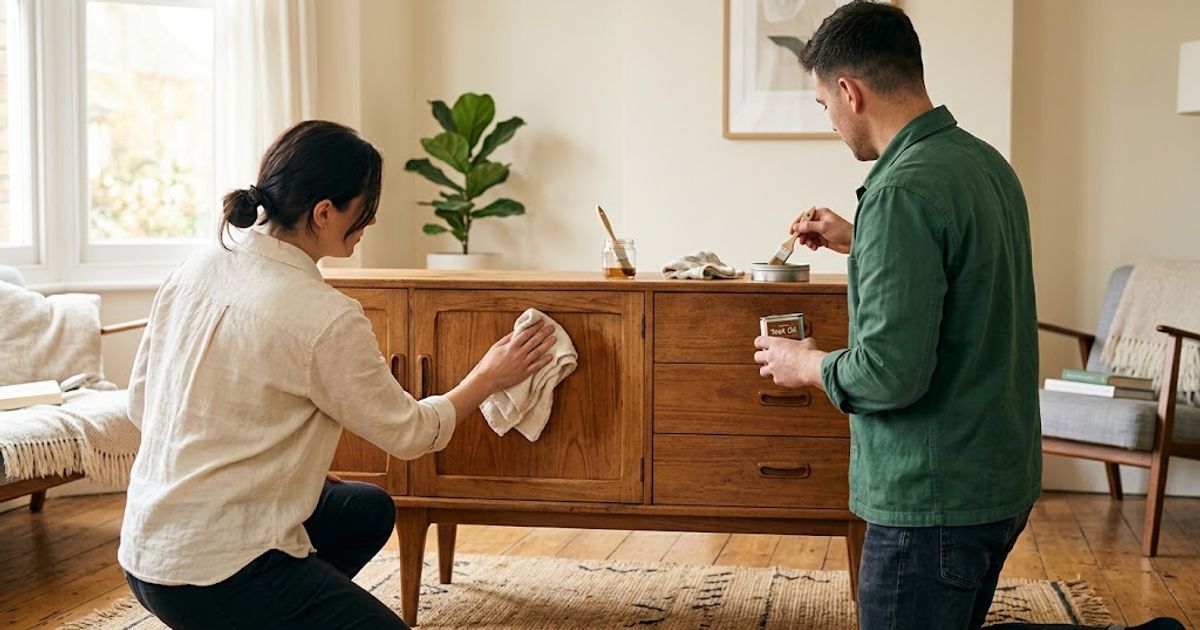
How to restore teak furniture indoors comes down to three steps: work out what finish it has, clean it gently, and choose a product that suits the surface. Plenty of mid-century teak has a hard coating that oil can’t soak into, so a clean and a restorative polish is often the better fix. Advice on oils conflicts, so this guide sets out what the manufacturer and a conservator actually say.
Secondhand mid-century teak sideboards, dining tables and coffee tables turn up in Melbourne homes all the time, and most can be revived without a full refinish. The risk is in the details: a product made for patio furniture, a sander on thin veneer, or an oil that has nowhere to go. Most advice on how to restore teak furniture is written for outdoor settings. This guide covers indoor teak, in the order that protects the piece.
How to Tell What Finish Your Teak Furniture Has
Before buying any product, find out what is on the surface. Finishing authority Bob Flexner sprayed furniture finishes while working in Denmark. He says Danish teak is usually finished with a catalysed varnish rather than oil, so owners are really caring for the finish, not the wood. Your piece may differ, especially if it was made elsewhere or has been refinished, so test a hidden spot such as the underside of the top.
Fine Homebuilding’s finish guide starts with the mildest test and works down, with gloves on and windows open. Its oil test uses boiled linseed oil. A drop of the oil you plan to use gives a similar clue, and there’s a reason below to avoid linseed.
Treat every result as a clue, not proof. Old wax, polish build-up or a layered refinish can all give ambiguous results.
| Test result | What it suggests | Next step |
|---|---|---|
| A drop of oil soaks in and the surface looks dry and matte | Oiled or bare timber | Clean, then consider a thin coat of interior penetrating oil |
| The drop beads on the surface | A hard finish (lacquer, varnish, shellac or polyurethane) | Don’t oil. Clean and use a restorer made for coated timber |
| Denatured alcohol (methylated spirits) turns the finish gummy | Possibly shellac | Avoid alcohol-based cleaners and get advice before refinishing |
| Yellow or brown residue on a rag dampened with mineral spirits | Possible wax or polish build-up, not proof | Clean it off and re-test the surface |
If the results are mixed, or the finish looks original on a piece you suspect is valuable, stop there. Getting it valued first is cheaper than undoing a refinish.
Is Your Teak Solid or Veneer?
Many mid-century pieces use teak veneer, a thin layer over another core, especially on tops and doors. Check the edge of the top and the underside: a different material beneath a thin teak face means veneer. Sanding through veneer can’t be undone, so don’t reach for a sander until you know what you have.
If you suspect the piece is an Australian hardwood rather than teak, the Australian timber identification guide helps. For makers such as Parker, the Australian mid-century furniture guide is worth reading before you touch the finish.
How to Clean Teak Furniture
- Dust with a soft, lint-free cloth.
- Wipe with a cloth wrung out in mild soapy water, then dry straight away. Don’t let water sit on the surface. The wooden table cleaning guide covers marks and rings in more detail.
- Remove grease or wax only if needed, using a cloth lightly dampened with mineral turpentine, after a test on a hidden spot. Feast Watson’s instructions for its interior oils call for a surface free of dirt, dust, grease, wax and oil.
- Let it dry fully before any product goes on.
Which Oil for Indoor Teak? Why the Advice Conflicts
Most “teak oil” advice online is about outdoor furniture. Feast Watson sells its Teak-coloured oil as an Outdoor Furniture Oil for timber outdoor furniture, and we found nothing from the company recommending it indoors. For interior furniture, its product pages list separate products:
- Scandinavian Oil is for interior woodwork including furniture. Feast Watson describes it as a clear blend of penetrating oils and resins that can go on raw or previously coated timber.
- Tung Oil Blend lists furniture among its uses. Feast Watson says previous polyurethane or varnish must be sanded back to bare timber first.
- Surface Restore is a tung oil, beeswax and carnauba formula for worn, coated interior timber. Feast Watson says it needs no sanding or stripping.
- Furniture Polish is for sealed interior timber only, not bare timber.
That raises a fair question: if Scandinavian Oil can go on previously coated timber, why not oil a hard finish? The manufacturer’s directions for coated timber involve abrading the surface with a scouring pad or fine steel wool, which dulls the existing finish. Our general rule is more cautious. Don’t oil an intact hard finish unless you’ve confirmed the product suits that surface, and always follow the label.
Linseed is where sources split. Dealer and hobbyist advice online ranges from recommending raw linseed thinned with mineral spirits to warning against linseed altogether. Conservator Marc Williams, writing to the conservation community’s mailing list, said linseed formulations cross-link, darken severely and feed mould and mildew. That post was about conserving wood generally, not mid-century teak, and we couldn’t find a conservator source on mid-century teak specifically. There is also no Australian standard for oiling teak furniture.
Our approach is cautious: skip linseed, match the product to the finish you found, and test a hidden spot first.
How to Oil Teak Furniture Indoors
Only oil teak that tested as bare or oiled and looks dry.
- Test a hidden spot. Oil deepens colour, and a patch is better than a surprise.
- Apply thinly. Use a clean, lint-free cloth and work along the grain.
- Wipe off the excess. For Scandinavian Oil, Feast Watson says to remove surface oil once it turns tacky and to allow 8 hours between coats. One coat is often enough. Add another only if the timber is still thirsty.
- Be patient. Feast Watson says the oil becomes marr-proof after about 8 days, so keep drinks and hot dishes off the piece until then.
- Handle rags safely. Rags soaked in drying oils can heat up and catch fire as the oil cures. Follow the disposal instructions on the product label. Feast Watson’s directions say to soak cloths in water before disposal, but check your own product’s label rather than assuming the same applies. Never leave oily rags balled up or in a bin.
To maintain it, repeat only when the timber looks dry again, on a clean, dry surface.
How to Restore Teak Furniture With a Hard Finish
If the drop beaded, oil will sit on top of the finish instead of feeding the wood. For a tired but intact finish, the gentler route is:
- Clean as above.
- Use a restorer made for coated timber, such as Surface Restore. Feast Watson applies it with a nylon scouring pad or fine steel wool along the grain, so test a hidden spot first.
- For a light refresh, use a polish made for sealed timber.
Avoid sanding thin veneer and then oiling it. Sanded patches can absorb oil differently and come up darker than the rest. Lifting veneer or a sand-through is a job for a professional restorer.
When to Leave Teak Furniture Alone
Light wear is part of a piece’s story. A faint ring or a small scratch rarely justifies stripping a finish. If the piece may be collectable, get it assessed before you refinish it.
Where to Find Teak Furniture Worth Restoring in Melbourne
Browse Zirkly’s vintage category for mid-century pieces, or look at listings from sellers in Fitzroy North. Inspect in person and look at the finish and the edges. Ask the seller whether the piece has been refinished or waxed, because that decides which of the paths above applies.
Conclusion: Whenever you restore teak furniture, use the same rule: test the finish, clean gently, then choose a product suited to the surface. Oil bare or oiled timber, restore a hard finish with a product made for coated timber, and leave a piece you can’t identify to a professional.
Restored a teak piece, or have a sideboard you’re ready to pass on? List it on Zirkly and let someone else give it another few decades.
Frequently Asked Questions
What’s the first step in restoring teak furniture?
Find out what finish it has. Test a hidden spot and treat the result as a clue, since the right product depends on whether the timber is bare, oiled or coated.
Do I need to oil indoor teak?
Not always. Bare or oiled teak that looks dry may benefit from a thin coat, but teak under a hard finish usually needs cleaning and a restorer, not oil.
What’s the best oil for indoor teak furniture?
No source we found names one best oil. Feast Watson lists Scandinavian Oil and Tung Oil Blend for bare or oiled interior timber and Surface Restore for worn coated timber. Check the label for your surface.
Is outdoor teak oil safe to use inside?
Feast Watson’s Teak-coloured oil is sold for outdoor furniture, and the company lists separate interior products. We found no Feast Watson guidance recommending the outdoor oil for indoor pieces.
Should I use linseed oil on teak?
Opinions differ. One conservator wrote that linseed formulations darken and support mould, though not about mid-century teak. We suggest a manufacturer’s interior product tested on a hidden spot.
How often does mid-century teak need re-oiling?
No source we found gives a fixed schedule. Re-oil only when the timber looks dry again.
Is it safe to sand teak furniture?
Only with care. Many mid-century pieces are veneered, and sanding through veneer is permanent. Check the edge and underside first, and ask a restorer if the veneer is lifting.
Where can I buy secondhand teak furniture in Melbourne?
Zirkly lists vintage and mid-century pieces from local sellers, including sideboards, tables and chairs. Inspect in person and ask whether the piece has been refinished.
Erica
Zirkly Team
Erica covers interior styling, furniture trends and the vintage pieces worth knowing about, helping Melbourne buyers and sellers make secondhand furniture feel like a deliberate choice rather than a compromise.