Safe Secondhand Furniture for Kids' Rooms in Melbourne
Secondhand furniture for kids' rooms can be safer and better-made than new flatpack. What to check, what to avoid, and what to anchor before anything stays.
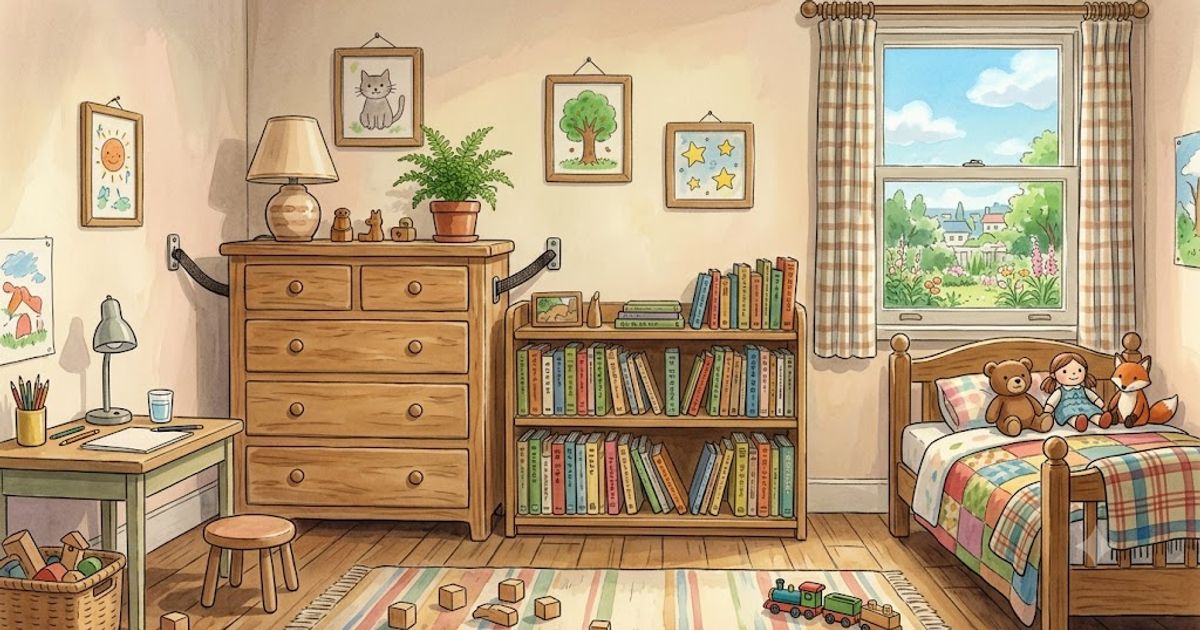
Buying secondhand furniture for a child's room is one of the most sensible things a parent can do — it's genuinely cheaper, the quality of older solid furniture is often better than new flatpack, and good kids' furniture has a natural second life as children grow out of it and someone else grows into it. But a children's room is also the one room in the house where a few extra checks genuinely matter before anything comes home.
This guide covers what to look for, what to avoid, and what to do with a piece once you've brought it home — so the furniture is safe as well as secondhand.
The two categories of safety concern in a child's room
Children's furniture safety tends to split into two categories that need different kinds of attention.
Structural and stability risks — furniture that can fall on a child. Tall chests of drawers, wardrobes and bookshelves have caused serious injuries and deaths across Australia, consistently involving young children who climb on open drawers or pull items off shelves. This is the most significant safety concern, it's well-documented, and it's addressed by a specific Australian regulatory requirement — more on that below.
Surface and finish risks — furniture with coatings, paints or materials a child might chew, mouth or spend significant time in close contact with. This matters most for very young children and for anything likely to take genuine physical contact (a cot rail, a low shelf, a little chair).
Both are real, both are manageable, and neither makes buying secondhand the wrong choice — they just change what you check before you buy.
The tipping-over problem — and what Australia now requires
Toppling furniture has killed at least 28 people in Australia since 2000 and causes nearly 20 injuries every week, with young children consistently the most at-risk group. A mandatory information standard came into effect in May 2022 requiring suppliers of certain types of household furniture — including chests of drawers, wardrobes and bookcases — to provide clear warnings and safety information to consumers at the point of sale and on the product itself. New mandatory compliance requirements were also updated in May 2025, though more than 90% of businesses were found by the ACCC to be non-compliant.
The standard applies to chests of drawers, wardrobes, bookcases, hall tables, display cabinets, buffets and sideboards with a height of 686mm or more, and entertainment units of any height.
For a secondhand buyer, this standard matters differently than it does for a new purchase. A secondhand piece won't come with the mandatory new-purchase warning labels — that's expected and fine. What the standard tells you is what to physically check: stability under pressure, drawer mechanisms that can't be used as climbing steps, and whether the piece needs anchoring before it goes anywhere near a child's room. Every piece you buy for a kids' room should be wall-anchored regardless of how stable it looks, full stop. Wall anchoring hardware is available from any hardware store and takes about twenty minutes to install properly.
Full guidance on assessing and anchoring a piece is at the Product Safety Australia toppling furniture guide.
What to check on every piece before buying
Before any secondhand furniture goes into a child's room, work through this in person with the piece in front of you:
Stability test. Pull out any top drawers of a chest of drawers or open doors on other furniture items and apply a little pressure to see how stable the furniture is. If the piece rocks or shifts under gentle pressure, it's not safe for a child's room without substantial anchoring — and even anchoring has limits on a genuinely unstable frame.
Drawer mechanisms. Drawers with locking devices help prevent children from opening them and using them as steps. Older furniture with smooth, easy-sliding drawers that pull all the way out are more of a concern than pieces with drawers that have a stop mechanism or require adult-level force.
Surface and finish. Look for peeling, flaking or damaged paint on anything a young child will have close contact with. Older Australian-made furniture (pre-1990s) is worth more attention here than European or post-2000 pieces, though risk is generally low if the surface is intact. If you're concerned, a non-toxic furniture wax or sealant applied after cleaning resolves most surface questions on solid timber at very low cost. Our guide to cleaning secondhand furniture properly covers the preparation that should happen before any secondhand piece comes inside.
Sharp edges and protrusions. Run your hand along every edge a child is likely to reach. Corner rounding that looks fine in an adult context can be sharper than expected at a toddler's eye level.
Anything with a mattress or sleeping surface. Our guide to checking secondhand furniture for bed bugs covers the inspection that applies to any upholstered surface or mattress before it comes inside.
For the broader quality checks — joinery, materials, structural soundness — our guide to telling if secondhand furniture is good quality covers the same fundamentals that make a piece worth buying for a child's room as for any other.
Furniture that grows with the child
One of the strongest arguments for secondhand in a kids' room is longevity — and the furniture choices that hold up best are the ones that don't need to be replaced the moment a child turns eight.
A good solid timber bed frame takes a toddler through to a teenager in a single-size, and a double can last indefinitely. Adjustable-height frames (with slat heights that can be lowered or removed as a child grows from cot to bed) are the version worth hunting for secondhand specifically, since they're increasingly hard to find new at a reasonable price.
Compact, open storage — low bookshelves and open bins — works across every age from toddler through to primary school, since access height is the only thing that really changes. The piece that holds stuffed animals at three is the same piece that holds books at nine.
A proper desk and chair combination that suits a school-age child. A secondhand timber desk bought at seven genuinely outlasts a plastic one bought new — our guide to setting up a home office with secondhand furniture covers desk ergonomics for adults, and the same sizing logic (right height, right depth, proper back support) applies scaled to a child.
Chest of drawers with low-set design. A chest of drawers that's stable, broad-based and lower-profile is a better choice for a child's room than a tall narrow one, regardless of how good the price is on the tall option.
What to avoid entirely
Three categories are consistent safety decisions rather than judgment calls:
Cots and bunk beds that don't clearly meet current Australian standards. Covered in detail in our guide to what secondhand furniture actually sells — the Product Safety Australia mandatory standards for both categories are specific and non-negotiable. If you can't confirm a cot or bunk meets the current standard, don't use it for a child regardless of how good it looks. The ACCC's mandatory standards for bunk beds and the Product Safety Australia cots guide are the authoritative references.
Recalled items. Before anything bought secondhand goes into a child's room, check whether it's on the Product Safety Australia recalls list. Takes two minutes, and the recalls database is searchable by product type.
Furniture with significant paint flaking or damage on contact surfaces. If the finish is failing on anything a young child will mouth or spend a lot of time against, either strip and refinish with a child-safe product first, or don't buy it. A piece in otherwise excellent structural condition is worth the refinishing effort; a piece that's structurally compromised as well is easier to pass on.
Once it's home: anchoring and finishing the job
Buying the piece safely is the first part. Installing it safely is the second, and it's where a lot of the actual risk lives — because even a genuinely stable piece of furniture can be tipped by a determined three-year-old.
Wall-anchor every tall piece in a child's room. This applies to wardrobes, tall chests of drawers, bookshelves and any freestanding unit over roughly 700mm. Wall anchoring kits are available at any hardware store, typically inexpensive, and the installation is a drill and two screws into a wall stud. The Product Safety Australia anchoring guide shows the correct method.
Give the surface a clean and, where useful, a treat. Solid timber benefits from a food-safe or child-safe oil or wax after cleaning — it protects the surface, brings out the grain, and removes any question about what might be in the existing finish.
Keep the heaviest items at the bottom. Furniture that is top-heavy is easier to tip over — distribute weight low once the piece is in the room.
Looking for furniture for a kids' room? Browse Zirkly's Kids Furniture listings in Melbourne — solid, well-made secondhand pieces that last longer than what a similar budget gets you new.
Frequently Asked Questions
Is secondhand furniture safe for a child's room?
Yes, with the right checks. Solid, well-made older furniture is often better quality than new flatpack at the same price — the extra step is a stability test before buying, wall-anchoring every tall piece once it's home, and checking any cot or bunk bed against current Australian mandatory standards before using it.
What secondhand furniture is unsafe for children?
Cots and bunk beds that don't clearly meet current Australian mandatory standards, recalled items, and any piece that can't be made stable when wall-anchored. A chest of drawers with a damaged or peeling surface finish on a young child's contact areas is also worth either refinishing or avoiding.
Should I wall-anchor secondhand furniture in a child's room?
Yes — every tall or free-standing piece, regardless of how stable it feels. The mandatory information standard exists because stable-looking furniture still tips when young children climb or pull on it. Wall anchoring is inexpensive, takes under half an hour, and eliminates the risk rather than just reducing it.
What should I look for when buying a secondhand kids' bedroom set?
Stability under pressure with drawers open, surface finish condition on anything a child touches closely, drawer mechanisms that resist being pulled all the way out, and correct sizing for the child's age now and in the next few years. For anything with a sleeping surface, also check for bed bugs.
Are old painted children's pieces safe?
Intact paint on older Australian furniture is generally low-risk, though if you're uncertain or the surface is flaking, a child-safe clear sealant or a strip-and-refinish is a straightforward fix. Risk is highest on pieces from before the 1970s, where lead-based paint was more common — if you're buying something that old for a young child, refinishing the surface is worth the extra step.
Where can I find secondhand kids' furniture in Melbourne?
Zirkly's Kids Furniture listings in Melbourne let you browse locally and inspect in person before buying — which matters more for a child's room than most.
Adam
Zirkly Team
Adam turns complex secondhand furniture topics into practical advice for Melbourne buyers and sellers — pricing, safety and the decisions that make buying and selling used furniture clearer.